


Well-chained space
In mathematics, a well-chained space is a metric space in which two arbitrary points can be connected by a chain of points that are arbitrarily close. It is closely related to the notion of connectedness.
Formal definition
[edit]A metric space is said to be well-chained if for every and every there exists and such that , and for every , one has .[1]: Ch. I §8 [2]


A set is well-chained if it is well-chained as a metric space with the distance restricted to .


Properties
[edit]A set is well-chained if and only if its topological closure is well-chained.
If is well-chained and if is uniformly continuous then the set is well-chained.[2]


Characterizations
[edit]The following properties are equivalent:[2]
- the space is well-chained;
- if and , then ;
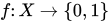
- if is uniformly continuous, then is constant.



Link with connectedness
[edit]Any well-chained set is connected.[1]: Ch. I §8
The converse fails in general:
- the set of rational numbers is well-chained but not connected,[1]: §I.8
- the set is well-chained but not connected.[3]: § 33


There are some situations where well-chainedness implies connectedness:

History
[edit]The definition of well-chained space was proposed as a definition of connected space (zusammenltiengende Punktmenge) by Georg Cantor in 1883.[4]: §11
In 1921, Maurice Fréchet names well-chained set (ensemble bien enchaîné) connected sets and proves, in the current terminology, that connected spaces are well-chained spaces.[3]: §33
The definition above appears in 1964 under the name of well-chained space in the book of Gordon Whyburn.[1]: §I.8
References
[edit]- 1 2 3 4 5 Whyburn, Gordon Thomas (1964). Topological Analysis (2 ed.). Princeton, N.J.: Princeton University Press.
- 1 2 3 4 Mathews, Jerold C. (March 1968). "A note on well-chained spaces". The American Mathematical Monthly. 75 (3): 273. doi:10.2307/2314959.
- 1 2 Fréchet, Maurice (1921). "Sur les ensembles abstraits". Annales scientifiques de l'École normale supérieure. 38: 341–388. doi:10.24033/asens.735.
- ↑ Cantor, Georg (December 1883). "Ueber unendliche, lineare Punktmannichfaltigkeiten". Mathematische Annalen. 21 (4): 545–591. doi:10.1007/BF01446819.