

User:Nasdn2/Numbers
| ||||
|---|---|---|---|---|
| Cardinal | 0, zero, nought, naught, nil, "oh" (/oʊ/) | |||
| Ordinal | Zeroth, noughth, 0th | |||
| Latin prefix | nulli- | |||
| Binary | 02 | |||
| Ternary | 03 | |||
| Senary | 06 | |||
| Octal | 08 | |||
| Duodecimal | 012 | |||
| Hexadecimal | 016 | |||
| Arabic, Kurdish, Persian, Sindhi, Urdu | ٠ | |||
| Hindu numerals | ० | |||
| Santali | ᱐ | |||
| Chinese | 零, 〇 | |||
| Burmese | ၀ | |||
| Khmer | ០ | |||
| Thai | ๐ | |||
| Assamese, Bengali | ০ | |||
| Maya numerals | 𝋠 | |||
| Morse code | _ _ _ _ _ | |||
0 (zero, /ˈziː.roʊ/) is a number representing an empty quantity. Adding (or subtracting) 0 to any number leaves that number unchanged; in mathematical terminology, 0 is the additive identity of the integers, rational numbers, real numbers, and complex numbers, as well as other algebraic structures. Multiplying any number by 0 results in 0, and consequently dividing by 0 is generally considered to be undefined in arithmetic.
As a numerical digit, 0 plays a crucial role in decimal notation: it indicates that the power of ten corresponding to the place containing a 0 does not contribute to the total. For example, "205" in decimal means two hundreds, no tens, and five ones. The same principle applies in place-value notations that uses a base other than ten, such as binary and hexadecimal. The modern use of 0 in this manner derives from Indian mathematics that was transmitted to Europe via medieval Islamic mathematicians and popularized by Fibonacci. It was independently used by the Maya.
Common names for the number 0 in English include zero, nought, naught (/nɔːt/), and nil. In contexts where at least one adjacent digit distinguishes it from the letter O, the number is sometimes pronounced as oh or o (/oʊ/). Informal or slang terms for 0 include zilch and zip. Historically, ought, aught (/ɔːt/), and cipher have also been used.
Etymology
[edit]The word zero came into the English language via French zéro from the Italian zero, a contraction of the Venetian zevero form of Italian zefiro, itself borrowed from Arabic ṣafira or ṣifr.[1]
In pre-Islamic time the word ṣifr (Arabic صفر) had the meaning "empty". Sifr evolved to mean zero when it was used to translate śūnya (Sanskrit: शून्य) from India.[2] The earliest known use of zero as a loanword in English literature was 1598.[3]
The Italian mathematician Fibonacci (c. 1170 – c. 1250), who grew up in North Africa and is credited with introducing the decimal system to Europe, used the term zephyrum. This became zefiro in Italian, and was then contracted to zero via the Venetian form zevero. The Italian word zefiro was already in existence (meaning "west wind" from Latin and Greek Zephyrus) and may have influenced the spelling when transcribing Arabic ṣifr.[4]
Modern usage
[edit]Depending on the context, there may be different words used for the number zero, or the concept of zero. For the simple notion of lacking, the words "nothing" (although this is not accurate) and "none" are often used. The English words "nought" or "naught", "nil", and null are also synonymous.[5][6]
It is often called "oh" in the context of reading out a string of digits, such as telephone numbers, street addresses, credit card numbers, military time, or years. For example, the area code 201 may be pronounced "two oh one", and the year 1907 is often pronounced "nineteen oh seven". The presence of other digits, indicating that the string contains only numbers, avoids confusion with the letter O. For this reason, systems that include strings with both letters and numbers (such as postcodes in the UK) may exclude the use of the letter O.[7]
Slang words for zero include "zip", "zilch", "nada", and "scratch".[8] In the context of sports, "nil" is sometimes used, especially in British English. Several sports have specific words for a score of zero, such as "love" in tennis – possibly from French l'œuf, "the egg" – and "duck" in cricket, a shortening of "duck's egg". "Goose egg" is another general slang term used for zero.[8]
Mathematics
[edit]The concept of zero plays multiple roles in mathematics: as a digit, it is an important part of positional notation for representing numbers, while it also plays an important role as a number in its own right in many algebraic settings.
As a digit
[edit]In positional number systems (such as the usual decimal notation for representing numbers), the digit 0 plays the role of a placeholder, indicating that certain powers of the base do not contribute. For example, the decimal number 205 is the sum of two hundreds and five ones, with the 0 digit indicating that no tens are added. The digit plays the same role in decimal fractions and in the decimal representation of other real numbers (indicating whether any tenths, hundredths, thousandths, etc., are present) and in bases other than 10 (for example, in binary, where it indicates which powers of 2 are omitted).[9]
Elementary algebra
[edit]
The number 0 is the smallest nonnegative integer, and the largest nonpositive integer. The natural number following 0 is 1 and no natural number precedes 0. The number 0 may or may not be considered a natural number,[10][11] but it is an integer, and hence a rational number and a real number.[12] Zero is even[13] (that is, a multiple of 2), and is also an integer multiple of any other integer.[14] It is neither a prime number nor a composite number.[15]
The number 0 is regarded as neither positive nor negative,[16] and is usually displayed as the origin of a number line.[17] When the real numbers are extended to form the complex numbers, 0 becomes the origin of the complex plane.[18]

The following are some basic rules for dealing with the number 0. These rules apply for any real or complex number x, unless otherwise stated.
- Addition: x + 0 = 0 + x = x. That is, 0 is an identity element (or neutral element) with respect to addition.[19]
- Subtraction: x − 0 = x and 0 − x = −x.[20]
- Multiplication: x · 0 = 0 · x = 0.[21] The converse also holds: If x · y = 0 then x=0 or y=0.
- Division: 0/x = 0, for nonzero x. But x/0 is undefined, because 0 has no multiplicative inverse (no real number multiplied by 0 produces 1), a consequence of the previous rule.[22]
- Exponentiation: x0 = x/x = 1, except that the case x = 0 is considered undefined in some contexts. For all positive real x, 0x = 0.[23]
The expression 0/0, which may be obtained in an attempt to determine the limit of an expression of the form f(x)/g(x) as a result of applying the lim operator independently to both operands of the fraction, is a so-called "indeterminate form". That does not mean that the limit sought is necessarily undefined; rather, it means that the limit of f(x)/g(x), if it exists, must be found by another method, such as l'Hôpital's rule.[24]
The sum of 0 numbers (the empty sum) is 0, and the product of 0 numbers (the empty product) is 1. The factorial 0! evaluates to 1, as a special case of the empty product.[25]
Other uses in mathematics
[edit]
The role of 0 as the smallest counting number can be generalized or extended in various ways. In set theory, 0 is the cardinality of the empty set (notated as "{ }", "", or "∅"): if one does not have any apples, then one has 0 apples. In fact, in certain axiomatic developments of mathematics from set theory, 0 is defined to be the empty set.[26] When this is done, the empty set is the von Neumann cardinal assignment for a set with no elements, which is the empty set.[27]

Also in set theory, 0 is the lowest ordinal number, corresponding to the empty set viewed as a well-ordered set. In order theory (and especially its subfield lattice theory), 0 may denote the least element of a lattice or other partially ordered set.
The role of 0 as additive identity generalizes beyond elementary algebra. In abstract algebra, 0 is commonly used to denote a zero element, which is the identity element for addition (if defined on the structure under consideration) and an absorbing element for multiplication (if defined). Examples include identity elements of additive groups and vector spaces. Another example is the zero function (or zero map) on a domain D. This is the constant function with 0 as its only possible output value, that is, it is the function f defined by f(x) = 0 for all x in D. As a function from the real numbers to the real numbers, the zero function is the only function that is both even and odd.
The number 0 is also used in several other ways within various branches of mathematics:
- A zero of a function f is a point x in the domain of the function such that f(x) = 0.
- In propositional logic, 0 may be used to denote the truth value false.
- In probability theory, 0 is the smallest allowed value for the probability of any event.[28]
- Category theory introduces the idea of a zero object, often denoted 0, and the related concept of zero morphisms, which generalize the zero function.[29]
History
[edit]Ancient Near East
[edit]| nfr |
heart with trachea beautiful, pleasant, good |
|
|---|

Ancient Egyptian numerals were of base 10.[30] They used hieroglyphs for the digits and were not positional. In one papyrus written around 1770 BC, a scribe recorded daily incomes and expenditures for the pharaoh's court, using the nfr hieroglyph to indicate cases where the amount of a foodstuff received was exactly equal to the amount disbursed. Egyptologist Alan Gardiner suggested that the nfr hieroglyph was being used as a symbol for zero.[31] The same symbol was also used to indicate the base level in drawings of tombs and pyramids, and distances were measured relative to the base line as being above or below this line.[32]
By the middle of the 2nd millennium BC, Babylonian mathematics had a sophisticated base 60 positional numeral system, but a positional value of zero was indicated by a space between numerals. In a tablet unearthed at Kish (dating to as early as 700 BC), the scribe Bêl-bân-aplu used three hooks as a placeholder.[33] By 300 BC, a punctuation symbol (two slanted wedges) was repurposed as a placeholder.[34][35] Significantly, however, these placeholder signs were not considered a numerical value, they were never used alone “Therefore, they cannot be interpreted as representations of the concept or the number zero.”[36] They were also not written at the end of a number (so 1 and 60 and 60×60 were all written as  ).[37]
Pre-Columbian Americas
[edit]
The Mesoamerican Long Count calendar developed in south-central Mexico and Central America required the use of zero as a placeholder within its vigesimal (base-20) positional numeral system. Many different glyphs, including the partial quatrefoil were used as a zero symbol for these Long Count dates, the earliest of which (on Stela 2 at Chiapa de Corzo, Chiapas) has a date of 36 BC.[a][38]
Since the eight earliest Long Count dates appear outside the Maya homeland,[39] it is generally believed that the use of zero in the Americas predated the Maya and was possibly the invention of the Olmecs.[40] Many of the earliest Long Count dates were found within the Olmec heartland, although the Olmec civilization ended by the 4th century BC,[41] several centuries before the earliest known Long Count dates.[42]
Although zero became an integral part of Maya numerals, with a different, empty tortoise-like "shell shape" used for many depictions of the "zero" numeral, it is assumed not to have influenced Old World numeral systems.[43]
Quipu, a knotted cord device, used in the Inca Empire and its predecessor societies in the Andean region to record accounting and other digital data, is encoded in a base ten positional system. Zero is represented by the absence of a knot in the appropriate position.[44]
Classical antiquity
[edit]The earliest confidently cited exemplar of the Greek use of the Hellenistic zero appears in Hipparchus in 140 CE.
The archaic Greece had no symbol for zero (μηδέν, pronounced mēdén), and did not use a digit placeholder for it.[45] According to mathematician Charles Seife, after the Babylonian placeholder zero shows up sometime shortly after 500 BC, Greek astronomers began to use the lowercase Greek letter ό (όμικρον: omicron) as a placeholder or representation of ground-level/null degree value.[46] However, after using the Babylonian placeholder zero for astronomical calculations they would typically convert the numbers back into Greek numerals. As with the rejection of infinitesimals by Pythagoras, Greeks appear to maintain to a philosophical opposition to using zero as a number.[47] "The whole of the Greek universe rested on this pillar: There is no void."[48] Nieder dates the appearance of zero in Greek astronomical texts after 400 BC and mathematician Robert Kaplan further specifies that it must have been after the conquests of Alexander.[49][50]
Greeks seemed unsure about the status of zero as a number. Some of them asked themselves, "How can not being be?", leading to philosophical and, by the medieval period, religious arguments about the nature and existence of zero and the vacuum. The paradoxes of Zeno of Elea depend in large part on the uncertain interpretation of zero.[51]

By AD 150, Ptolemy, influenced by Hipparchus and the Babylonians, was using a symbol for zero ()[52][53] in his work on mathematical astronomy called the Syntaxis Mathematica, also known as the Almagest.[54] This Hellenistic zero was perhaps the earliest documented use of a numeral representing zero in the Old World.[55] Ptolemy used it many times in his Almagest (VI.8) for the magnitude of solar and lunar eclipses. It represented the value of both digits and minutes of immersion at first and last contact. Digits varied continuously from 0 to 12 to 0 as the Moon passed over the Sun (a triangular pulse), where twelve digits was the angular diameter of the Sun. Minutes of immersion was tabulated from 0′0″ to 31′20″ to 0′0″, where 0′0″ used the symbol as a placeholder in two positions of his sexagesimal positional numeral system,[b] while the combination meant a zero angle. Minutes of immersion was also a continuous function 1/12 31′20″ √d(24−d) (a triangular pulse with convex sides), where d was the digit function and 31′20″ was the sum of the radii of the Sun's and Moon's discs.[56] Ptolemy's symbol was a placeholder as well as a number used by two continuous mathematical functions, one within another, so it meant zero, not none. Over time, Ptolemy's zero tended to increase in size and lose the overline, sometimes depicted as a large elongated 0-like omicron "Ο" or as omicron with overline "ō" instead of a dot with overline.[57]
The earliest use of zero in the calculation of the Julian Easter occurred before AD 311, at the first entry in a table of epacts as preserved in an Ethiopic document for the years 311 to 369, using a Geʽez word for "none" (English translation is "0" elsewhere) alongside Geʽez numerals (based on Greek numerals), which was translated from an equivalent table published by the Church of Alexandria in Medieval Greek.[58] This use was repeated in 525 in an equivalent table, that was translated via the Latin nulla ("none") by Dionysius Exiguus, alongside Roman numerals.[59] When division produced zero as a remainder, nihil, meaning "nothing", was used. These medieval zeros were used by all future medieval calculators of Easter. The initial "N" was used as a zero symbol in a table of Roman numerals by Bede—or his colleagues—around AD 725.[60]
China
[edit]
The Sūnzĭ Suànjīng, of unknown date but estimated to be dated from the 1st to 5th centuries AD, describe how the 4th century BC Chinese counting rods system enabled one to perform positional decimal calculations.[62][63] As noted in the Xiahou Yang Suanjing (425–468 AD), to multiply or divide a number by 10, 100, 1000, or 10000, all one needs to do, with rods on the counting board, is to move them forwards, or back, by 1, 2, 3, or 4 places.[64] The rods gave the decimal representation of a number, with an empty space denoting zero.[61][65] A circa 190 AD, manual, the "Supplementary Notes on the Art of Figures", by Xu Yue, also outlines the techniques to add, subtract, multiply, and divide numbers, containing zero values in a decimal power, on counting devices, that include counting rods, and abacus.[66][67] Chinese authors had been familiar with the idea of negative numbers, and decimal fractions, by the Han dynasty (2nd century AD), as seen in The Nine Chapters on the Mathematical Art.[68] Qín Jiǔsháo's 1247 Mathematical Treatise in Nine Sections is the oldest surviving Chinese mathematical text using a round symbol '〇' for zero.[69] The origin of this symbol is unknown; it may have been produced by modifying a square symbol.[70] Zero was not treated as a number at that time, but as a "vacant position".[71]
Chinese Epigraphy
[edit]A variety of Chinese characters have been used, through history, to represent zero: 空, 零, 洞, 〇.
India
[edit]Pingala (c. 3rd or 2nd century BC),[72] a Sanskrit prosody scholar,[73] used binary sequences, in the form of short and long syllables (the latter equal in length to two short syllables), to identify the possible valid Sanskrit meters, a notation similar to Morse code.[74] Pingala used the Sanskrit word śūnya explicitly to refer to zero.[72]

A decimal place value grapheme for zero was developed in India.[76]
The Lokavibhāga, a Jain text on cosmology surviving in a medieval Sanskrit translation of the Prakrit original, which is internally dated to AD 458 (Saka era 380), uses a decimal place-value system, including a zero. In this text, śūnya ("void, empty") is also used to refer to zero.[77]
The Aryabhatiya (c. 499), states sthānāt sthānaṁ daśaguṇaṁ syāt "from place to place each is ten times the preceding".[78][79][80]
Rules governing the use of zero appeared in Brahmagupta's Brahmasputha Siddhanta (7th century), which states the sum of zero with itself as zero, and incorrectly describes division by zero in the following way:[81][82]
A positive or negative number when divided by zero is a fraction with the zero as denominator. Zero divided by a negative or positive number is either zero or is expressed as a fraction with zero as numerator and the finite quantity as denominator. Zero divided by zero is zero.
Bhāskara II's 12th century treatise Līlāvatī instead proposed that division by zero results in an infinite quantity,[83]
A quantity divided by zero becomes a fraction the denominator of which is zero. This fraction is termed an infinite quantity. In this quantity consisting of that which has zero for its divisor, there is no alteration, though many may be inserted or extracted; as no change takes place in the infinite and immutable God when worlds are created or destroyed, though numerous orders of beings are absorbed or put forth.
Early Asian Epigraphy
[edit]


There are numerous copper plate inscriptions with the same small o in them, some of them possibly dated to the 6th century, but their date or authenticity may be open to doubt.[33]
A stone tablet found in the ruins of a temple near Sambor on the Mekong, Kratié Province, Cambodia, includes the inscription of "605" in Khmer numerals (a set of numeral glyphs for the Hindu–Arabic numeral system). The number is the year of the inscription in the Saka era, corresponding to a date of AD 683.[84]
The first known use of special glyphs for the decimal digits that includes the indubitable appearance of a symbol for the digit zero, a small circle, appears on a stone inscription found at the Chaturbhuj Temple, Gwalior, in India, dated AD 876.[85][86]
A symbol for zero, a black dot, is used throughout the Bakhshali manuscript, a practical manual on arithmetic for merchants. The Bodleian Library reported radiocarbon dating results for six folio from the manuscript, indicating that they came from different centuries, but date the manuscript to AD 799 – 1102.[75]
Middle Ages
[edit]Transmission to Islamic culture
[edit]The Arabic-language inheritance of science was largely Greek,[87] followed by Hindu influences.[88] In 773, at Al-Mansur's behest, translations were made of many ancient treatises including Greek, Roman, Indian, and others.
In AD 813, astronomical tables were prepared by a Persian mathematician, Muḥammad ibn Mūsā al-Khwārizmī, using Hindu numerals;[88] and about 825, he published a book synthesizing Greek and Hindu knowledge and also contained his own contribution to mathematics including an explanation of the use of zero.[89] This book was later translated into Latin in the 12th century under the title Algoritmi de numero Indorum. This title means "al-Khwarizmi on the Numerals of the Indians". The word "Algoritmi" was the translator's Latinization of Al-Khwarizmi's name, and the word "Algorithm" or "Algorism" started to acquire a meaning of any arithmetic based on decimals.[88]
Muhammad ibn Ahmad al-Khwarizmi, in 976, stated that if no number appears in the place of tens in a calculation, a little circle should be used "to keep the rows". This circle was called ṣifr.[90]
Transmission to Europe
[edit]The Hindu–Arabic numeral system (base 10) reached Western Europe in the 11th century, via Al-Andalus, through Spanish Muslims, the Moors, together with knowledge of classical astronomy and instruments like the astrolabe. Gerbert of Aurillac is credited with reintroducing the lost teachings into Catholic Europe. For this reason, the numerals came to be known in Europe as "Arabic numerals". The Italian mathematician Fibonacci or Leonardo of Pisa was instrumental in bringing the system into European mathematics in 1202, stating:
After my father's appointment by his homeland as state official in the customs house of Bugia for the Pisan merchants who thronged to it, he took charge; and in view of its future usefulness and convenience, had me in my boyhood come to him and there wanted me to devote myself to and be instructed in the study of calculation for some days. There, following my introduction, as a consequence of marvelous instruction in the art, to the nine digits of the Hindus, the knowledge of the art very much appealed to me before all others, and for it I realized that all its aspects were studied in Egypt, Syria, Greece, Sicily, and Provence, with their varying methods; and at these places thereafter, while on business. I pursued my study in depth and learned the give-and-take of disputation. But all this even, and the algorism, as well as the art of Pythagoras, I considered as almost a mistake in respect to the method of the Hindus [Modus Indorum]. Therefore, embracing more stringently that method of the Hindus, and taking stricter pains in its study, while adding certain things from my own understanding and inserting also certain things from the niceties of Euclid's geometric art. I have striven to compose this book in its entirety as understandably as I could, dividing it into fifteen chapters. Almost everything which I have introduced I have displayed with exact proof, in order that those further seeking this knowledge, with its pre-eminent method, might be instructed, and further, in order that the Latin people might not be discovered to be without it, as they have been up to now. If I have perchance omitted anything more or less proper or necessary, I beg indulgence, since there is no one who is blameless and utterly provident in all things. The nine Indian figures are: 9 8 7 6 5 4 3 2 1. With these nine figures, and with the sign 0 ... any number may be written.[91]
From the 13th century, manuals on calculation (adding, multiplying, extracting roots, etc.) became common in Europe where they were called algorismus after the Persian mathematician al-Khwārizmī. One popular manual was written by Johannes de Sacrobosco in the early 1200s and was one of the earliest scientific books to be printed, in 1488.[92][93] The practice of calculating on paper using Hindu–Arabic numerals only gradually displaced calculation by abacus and recording with Roman numerals.[94] In the 16th century, Hindu–Arabic numerals became the predominant numerals used in Europe.[92]
Symbols and representations
[edit]

Today, the numerical digit 0 is usually written as a circle or ellipse. Traditionally, many print typefaces made the capital letter O more rounded than the narrower, elliptical digit 0.[95] Typewriters originally made no distinction in shape between O and 0; some models did not even have a separate key for the digit 0. The distinction came into prominence on modern character displays.[95]
A slashed zero () is often used to distinguish the number from the letter (mostly in computing, navigation and in the military, for example). The digit 0 with a dot in the center seems to have originated as an option on IBM 3270 displays and has continued with some modern computer typefaces such as Andalé Mono, and in some airline reservation systems. One variation uses a short vertical bar instead of the dot. Some fonts designed for use with computers made the "0" character more squared at the edges, like a rectangle, and the "O" character more rounded. A further distinction is made in falsification-hindering typeface as used on German car number plates by slitting open the digit 0 on the upper right side. In some systems either the letter O or the numeral 0, or both, are excluded from use, to avoid confusion.[citation needed]

Physics
[edit]The value zero plays a special role for many physical quantities. For some quantities, the zero level is naturally distinguished from all other levels, whereas for others it is more or less arbitrarily chosen. For example, for an absolute temperature (typically measured in kelvins), zero is the lowest possible value. (Negative temperatures can be defined for some physical systems, but negative-temperature systems are not actually colder.) This is in contrast to temperatures on the Celsius scale, for example, where zero is arbitrarily defined to be at the freezing point of water.[96][97] Measuring sound intensity in decibels or phons, the zero level is arbitrarily set at a reference value—for example, at a value for the threshold of hearing.[98][99]
Computer science
[edit]Modern computers store information in binary, that is, using an "alphabet" that contains only two symbols, usually chosen to be "0" and "1". Binary coding is convenient for digital electronics, where "0" and "1" can stand for the absence or presence of electrical current in a wire.[100] Computer programmers typically use high-level programming languages that are more intelligible to humans than the binary instructions that are directly executed by the central processing unit. 0 plays various important roles in high-level languages. For example, a Boolean variable stores a value that is either true or false, and 0 is often the numerical representation of false.[101]
0 also plays a role in array indexing. The most common practice throughout human history has been to start counting at one, and this is the practice in early classic programming languages such as Fortran and COBOL.[102] However, in the late 1950s LISP introduced zero-based numbering for arrays while Algol 58 introduced completely flexible basing for array subscripts (allowing any positive, negative, or zero integer as base for array subscripts), and most subsequent programming languages adopted one or other of these positions.[citation needed] For example, the elements of an array are numbered starting from 0 in C, so that for an array of n items the sequence of array indices runs from 0 to n−1.[103] Since C arrays are accessed by the array's first element memory address plus an offset, the initial pointer plus with offset zero refers to the first element of the array.
There can be confusion between 0- and 1-based indexing; for example, Java's JDBC indexes parameters from 1 although Java itself uses 0-based indexing.[104]
In C, a byte containing the value 0 serves to indicate where a string of characters ends. Also, 0 is a standard way to refer to a null pointer in code.[105]
In databases, it is possible for a field not to have a value. It is then said to have a null value.[106] For numeric fields it is not the value zero. For text fields this is not blank nor the empty string. The presence of null values leads to three-valued logic. No longer is a condition either true or false, but it can be undetermined. Any computation including a null value delivers a null result.[107]
In mathematics, there is no "positive zero" or "negative zero" distinct from zero; both −0 and +0 represent exactly the same number. However, in some computer hardware signed number representations, zero has two distinct representations, a positive one grouped with the positive numbers and a negative one grouped with the negatives. This kind of dual representation is known as signed zero, with the latter form sometimes called negative zero. These representations include the signed magnitude and ones' complement binary integer representations (but not the two's complement binary form used in most modern computers), and most floating-point number representations (such as IEEE 754 and IBM S/360 floating-point formats).
An epoch, in computing terminology, is the date and time associated with a zero timestamp. The Unix epoch begins the midnight before the first of January 1970.[108][109][110] The Classic Mac OS epoch and Palm OS epoch begin the midnight before the first of January 1904.[111]
Many APIs and operating systems that require applications to return an integer value as an exit status typically use zero to indicate success and non-zero values to indicate specific error or warning conditions.[112]
Programmers often use a slashed zero to avoid confusion with the letter "O".[113]
Other fields
[edit]Biology
[edit]In comparative zoology and cognitive science, recognition that some animals display awareness of the concept of zero leads to the conclusion that the capability for numerical abstraction arose early in the evolution of species.[114]
Dating systems
[edit]In the BC calendar era, the year 1 BC is the first year before AD 1; there is not a year zero. By contrast, in astronomical year numbering, the year 1 BC is numbered 0, the year 2 BC is numbered −1, and so forth.[115]
See also
[edit]Notes
[edit]- ↑ No long count date actually using the number 0 has been found before the 3rd century AD, but since the long count system would make no sense without some placeholder, and since Mesoamerican glyphs do not typically leave empty spaces, these earlier dates are taken as indirect evidence that the concept of 0 already existed at the time.
- ↑ Each place in Ptolemy's sexagesimal system was written in Greek numerals from 0 to 59, where 31 was written λα meaning 30+1, and 20 was written κ meaning 20.
References
[edit]- ↑
- Harper, Douglas (2011). "Zero". Etymonline. Archived from the original on 3 July 2017.
"figure which stands for naught in the Arabic notation," also "the absence of all quantity considered as quantity", c. 1600, from French zéro or directly from Italian zero, from Medieval Latin zephirum, from Arabic sifr "cipher", translation of Sanskrit sunya-m "empty place, desert, naught
- Menninger, Karl (1992). Number Words and Number Symbols: A cultural history of numbers. Courier Dover Publications. pp. 399–404. ISBN 978-0-486-27096-8. Retrieved 5 January 2016.
- "zero, n." OED Online. Oxford University Press. December 2011. Archived from the original on 7 March 2012. Retrieved 4 March 2012.
French zéro (1515 in Hatzfeld & Darmesteter) or its source Italian zero, for *zefiro, Arabic çifr.
- Harper, Douglas (2011). "Zero". Etymonline. Archived from the original on 3 July 2017.
- ↑
- Smithsonian Institution. Oriental Elements of Culture in the Occident, p. 518, at Google Books. Annual Report of the Board of Regents of the Smithsonian Institution; Harvard University Archives. "Sifr occurs in the meaning of "empty" even in the pre-Islamic time. ... Arabic sifr in the meaning of zero is a translation of the corresponding India sunya."
- Gullberg, Jan (1997). Mathematics: From the Birth of Numbers. W.W. Norton & Co. ISBN 978-0-393-04002-9. p. 26:
Zero derives from Hindu sunya – meaning void, emptiness – via Arabic sifr, Latin cephirum, Italian zevero.
- Logan, Robert (2010). The Poetry of Physics and the Physics of Poetry. World Scientific. ISBN 978-981-4295-92-5. p. 38:
The idea of sunya and place numbers was transmitted to the Arabs who translated sunya or "leave a space" into their language as sifr.
- ↑ "The Origin Of The Word 'Zero'". Science Friday. 17 July 2018. Retrieved 2025-11-27.
- ↑ Ifrah 2000, p. 589.
- ↑ "Collins – Free online dictionary". 19 May 2026.
- ↑ "Collins – Free online dictionary, thesaurus and reference materials – nill". 19 May 2026.
- ↑ "Appendix C - Valid Postcode Format" (PDF). gov.uk. 28 April 2017. Retrieved 24 July 2025.
- 1 2 "'Aught' synonyms". Thesaurus.com. Archived from the original on 23 August 2014. Retrieved 23 April 2013.
- ↑ Reimer 2014, pp. 156, 199–204.
- ↑ Bunt, Lucas Nicolaas Hendrik; Jones, Phillip S.; Bedient, Jack D. (1976). The historical roots of elementary mathematics. Courier Dover Publications. pp. 254–255. ISBN 978-0-486-13968-5. Archived from the original on 23 June 2016. Retrieved 5 January 2016., Extract of pp. 254–255 Archived 10 May 2016 at the Wayback Machine
- ↑ Cheng 2017, p. 32.
- ↑ Cheng 2017, pp. 41, 48–53.
- ↑ Lemma B.2.2, The integer 0 is even and is not odd, in Penner, Robert C. (1999). Discrete Mathematics: Proof Techniques and Mathematical Structures. World Scientific. p. 34. ISBN 978-981-02-4088-2.
- ↑ Cummings, Jay (2021). Proofs: a long-form mathematics textbook. Wrocław: Amazon Fulfillment. ISBN 979-8-5952-6597-3.
- ↑ "Prime and Composite Numbers". www.aaamath.com. Retrieved 2026-06-18.
- ↑ Weisstein, Eric W. "Zero". Wolfram. Archived from the original on 1 June 2013. Retrieved 4 April 2018.
- ↑ Moise, Edwin E. (1996). Calculus (part 1 ed.). Addison-Wesley Publishing Company, Inc. p. 18.
- ↑ Foerster 1980, p. 283.
- ↑ Foerster 1980, p. 3.
- ↑ "Subtracting Integers Rules: Definition and Rules with Examples". Testbook. Retrieved 2026-06-18.
- ↑ Foerster 1980, p. 21.
- ↑ Cheng 2017, p. 47.
- ↑ Foerster 1980, p. 136.
- ↑ Herman, Edwin; Strang, Gilbert; et al. (2017). Calculus. Vol. 1. Houston, Texas: OpenStax. pp. 454–459. ISBN 978-1-938168-02-4. OCLC 1022848630. Archived from the original on 23 September 2022. Retrieved 26 July 2022.
- ↑ Graham, Ronald L.; Knuth, Donald E.; Patashnik, Oren (1988). Concrete Mathematics. Reading, MA: Addison-Wesley. p. 111. ISBN 0-201-14236-8.
- ↑ Cheng 2017, p. 60.
- ↑ Booher, Jeremy. "CONSTRUCTING THE INTEGERS: N, ORDINAL NUMBERS, AND TRANSFINITE ARITHMETIC" (PDF). University of Florida.
- ↑ Kardar 2007, p. 35.
- ↑ Riehl, Emily (2016). Category Theory in Context. Dover. p. 103. ISBN 978-0-486-80903-8.
- ↑ O'Connor, J. J.; Robertson, E. F. (2000). "Egyptian numerals". mathshistory.st-andrews.ac.uk. University of St Andrews. Archived from the original on 15 November 2019. Retrieved 21 December 2019.
- ↑ eg. Alan Gardiner. “§357. Other Modes of Negation” Egyptian Grammar (1927). p. 266 etc. et. al. Cites: Cairo 20003. Turin 1447. British Museum MS 152.
- ↑ Lumpkin, Beatrice (2002). "Mathematics Used in Egyptian Construction and Bookkeeping". The Mathematical Intelligencer. 24 (2): 20–25. doi:10.1007/BF03024613. S2CID 120648746.
- 1 2 Kaplan 2000.
- ↑ O'Connor, J. J.; Robertson, E. F. (2000). "Zero". Maths History. University of St Andrews. Archived from the original on 21 September 2021. Retrieved 2021-09-07.
- ↑ "Babylonian mathematics". The Open University. 2016. Archived from the original on 7 September 2021. Retrieved 2021-09-07.
- ↑ Nieder, Andreas (19 November 2019). A Brain for Numbers: The Biology of the Number Instinct. MIT Press. p. 286.
- ↑ Reimer 2014, p. 172.
- ↑ "Cyclical views of time". www.mexicolore.co.uk. Retrieved 2024-01-20.
- ↑ Diehl (2004), p. 186.
- ↑ Mortaigne, Véronique (28 November 2014). "The golden age of Mayan civilisation – exhibition review". The Guardian. Archived from the original on 28 November 2014. Retrieved 10 October 2015.
- ↑ Cyphers, Ann (2014). "The Olmec, 1800–400 BCE". In Renfrew, Colin; Bahn, Paul (eds.). The Cambridge World Prehistory. Cambridge: Cambridge University Press. pp. 1005–1025. ISBN 978-0-521-11993-1. Retrieved 2024-08-13.
- ↑ "Expedition Magazine | Time, Kingship, and the Maya Universe Maya Calendars". Expedition Magazine. Retrieved 2024-08-13.
- ↑ Birchak, Gabrielle (2025-06-03). "Mayan Mathematics". Math! Science! History!™. Retrieved 2025-09-30.
Historian Georges Ifrah calls the Mayan use of zero "one of the most striking inventions ever to emerge in a mathematical culture isolated from the Old World."
- ↑ Leon, Manuel de (2022-12-20). "Knots representing numbers: The mathematics of the Incas". EL PAÍS English. Retrieved 2024-06-05.
- ↑ Wallin, Nils-Bertil (19 November 2002). "The History of Zero". YaleGlobal online. The Whitney and Betty Macmillan Center for International and Area Studies at Yale. Archived from the original on 25 August 2016. Retrieved 1 September 2016.
- ↑ Kaplan, Robert (1999). The nothing that is : a natural history of zero. Internet Archive. London: Allen Lane. p. 18. ISBN 978-0-7139-9284-7.
- ↑ Seife 2000, p. 39.
- ↑ Seife 2000, p. 25.
- ↑ Nieder, Andreas (19 November 2019). A Brain for Numbers: The Biology of the Number Instinct. MIT Press. p. 286. ISBN 978-0-262-35432-5. Retrieved 30 April 2022.
- ↑ Kaplan 2000, p. 17.
- ↑ Huggett, Nick (2019). "Zeno's Paradoxes". In Zalta, Edward N. (ed.). The Stanford Encyclopedia of Philosophy (Winter 2019 ed.). Metaphysics Research Lab, Stanford University. Archived from the original on 10 January 2021. Retrieved 2020-08-09.
- ↑ Neugebauer, Otto (1969) [1957]. The Exact Sciences in Antiquity (2 ed.). Dover Publications. pp. 13–14, plate 2. ISBN 978-0-486-22332-2.
- ↑ Mercier, Raymond. "Consideration of the Greek symbol 'zero'" (PDF). Home of Kairos. Archived (PDF) from the original on 5 November 2020. Retrieved 28 March 2020.[self-published source?]
- ↑ Ptolemy (1998) [1984, c.150]. Ptolemy's Almagest. Translated by Toomer, G. J. Princeton University Press. pp. 306–307. ISBN 0-691-00260-6.
- ↑ O'Connor, J. J.; Robertson, E. F. "A history of Zero". MacTutor History of Mathematics. Archived from the original on 7 April 2020. Retrieved 28 March 2020.
- ↑ Pedersen, Olaf (2010) [1974]. Alexander Jones (ed.). A Survey of the Almagest. Sources and Studies in the History of Mathematics and Physical Sciences. Springer. pp. 232–235. doi:10.1007/978-0-387-84826-6_7. ISBN 978-0-387-84825-9.
- ↑ "Proposal to encode the Greek Zero in the UCS" (PDF). 2024-07-31. Archived (PDF) from the original on 2022-10-07.
- ↑ Neugebauer, Otto (2016) [1979]. Ethiopic Astronomy and Computus (Red Sea Press ed.). Red Sea Press. pp. 25, 53, 93, 183, Plate I. ISBN 978-1-56902-440-9.. The pages in this edition have numbers six less than the same pages in the original edition.
- ↑ Deckers, Michael (2003) [525]. "Cyclus Decemnovennalis Dionysii" [Nineteen Year Cycle of Dionysius]. Archived from the original on 15 January 2019.
- ↑ C. W. Jones, ed., Opera Didascalica, vol. 123C in Corpus Christianorum, Series Latina.
- 1 2 Hodgkin, Luke (2005). A History of Mathematics: From Mesopotamia to Modernity. Oxford University Press. p. 85. ISBN 978-0-19-152383-0.
- ↑ Shen, Crossley & Lun 1999, p. 12: "the ancient Chinese system is a place notation system"
- ↑ Eberhard-Bréard, Andrea (2008). "Mathematics in China". In Selin, Helaine (ed.). Encyclopaedia of the History of Science, Technology, and Medicine in Non-Western Cultures. Dordrecht: Springer Netherlands. pp. 1371–1378. doi:10.1007/978-1-4020-4425-0_9453. ISBN 978-1-4020-4425-0..
- ↑ O'Connor, John J.; Robertson, Edmund F. (January 2004). "Chinese numerals". MacTutor History of Mathematics Archive. University of St Andrews.
- ↑ O'Connor, J J; Robertson, E F. "Chinese numerals". Maths History. Retrieved 2024-04-28.
- ↑ K. Volkov, Alexeï (1994). "Large Numbers and Counting Rods". Extrême-Orient, Extrême-Occident. 16 (16): 71–92. doi:10.3406/oroc.1994.991.
- ↑ "City News Service | Shanghai and China City News Service and Life Guide". www.citynewsservice.cn. Retrieved 2025-07-01.
- ↑ Struik, Dirk J. (1987). A Concise History of Mathematics. New York: Dover Publications. pp. 32–33.
In these matrices we find negative numbers, which appear here for the first time in history.
- ↑ "Mathematics in the Near and Far East" (PDF). grmath4.phpnet.us. p. 262. Archived (PDF) from the original on 4 November 2013. Retrieved 7 June 2012.
- ↑ Martzloff, Jean-Claude (2007). A History of Chinese Mathematics. Translated by Wilson, Stephen S. Springer. p. 208. ISBN 978-3-540-33783-6.
- ↑ Shen Kanshen Crossley, John N.; Lun, Anthony W.-C. (1999). The Nine Chapters on the Mathematical Art: Companion and Commentary. Oxford University Press. p. 35. ISBN 978-0-19-853936-0.
zero was regarded as a number in India ... whereas the Chinese employed a vacant position
- 1 2 Plofker, Kim (2009). Mathematics in India. Princeton University Press. pp. 54–56. ISBN 978-0-691-12067-6.
In the Chandah-sutra of Pingala, dating perhaps the third or second century BC, [ ...] Pingala's use of a zero symbol [śūnya] as a marker seems to be the first known explicit reference to zero. ... In the Chandah-sutra of Pingala, dating perhaps the third or second century BC, there are five questions concerning the possible meters for any value "n". [ ...] The answer is (2)7 = 128, as expected, but instead of seven doublings, the process (explained by the sutra) required only three doublings and two squarings – a handy time saver where "n" is large. Pingala's use of a zero symbol as a marker seems to be the first known explicit reference to zero.
- ↑ Vaman Shivaram Apte (1970). "Sanskrit Prosody and Important Literary and Geographical Names in the Ancient History of India". The Student's Sanskrit-English Dictionary. Motilal Banarsidass. pp. 648–649. ISBN 978-81-208-0045-8. Retrieved 21 April 2017.
- ↑ Hall, Rachel (February 15, 2005). "Math for Poets and Drummers: The Mathematics of Rhythm" (PDF) (slideshow). Saint Joseph's University. Archived from the original (PDF) on 22 January 2019. Retrieved 20 December 2015.
- 1 2 Chivall, David (2024). "Radiocarbon dating of the Bakhshālī manuscript".
- ↑ Bourbaki 1998, p. 46.
- ↑ Ifrah (2000), p. 416.
- ↑ Aryabhatiya of Aryabhata, translated by Walter Eugene Clark.
- ↑ O'Connor, J. J.; Robertson, E. F. (2000). "Aryabhata the Elder". School of Mathematics and Statistics, University of St. Andrews. Scotland. Archived from the original on 11 July 2015. Retrieved 26 May 2013.
- ↑ Hosch, William L., ed. (15 August 2010). The Britannica Guide to Numbers and Measurement (Math Explained). The Rosen Publishing Group. pp. 97–98. ISBN 978-1-61530-108-9. Retrieved 26 September 2016.
- ↑ Algebra, with Arithmetic and Mensuration from the Sanscrit of Brahmegupta and Bháscara. Translated by Henry Thomas Colebrooke. London, England: John Murray. 1817. OCLC 1039515732.
- ↑ Kaplan 2000, p. 68–75.
- ↑ Roy, Rahul (January 2003). "Babylonian Pythagoras' Theorem, the Early History of Zero and a Polemic on the Study of the History of Science". Resonance. 8 (1): 30–40. doi:10.1007/BF02834448.
- ↑
- Cœdès, George (1931). "A propos de l'origine des chiffres arabes". Bulletin of the School of Oriental Studies, University of London (in French). 6 (2). Cambridge University Press: 323–328. doi:10.1017/S0041977X00092806. JSTOR 607661. S2CID 130482979.
- Diller, Anthony (1996). "New Zeros and Old Khmer" (PDF). Mon-Khmer Studies. 25: 125–132.
- ↑ Casselman, Bill. "All for Nought". ams.org. University of British Columbia), American Mathematical Society. Archived from the original on 6 December 2015. Retrieved 20 December 2015.
- ↑ Ifrah (2000), p. 400.
- ↑ Pannekoek, Anton (1961). A History of Astronomy. George Allen & Unwin. p. 165. OCLC 840043.
- 1 2 3 Durant, Will (1950). The Story of Civilization, Volume IV, The Age of Faith: Constantine to Dante – A.D. 325–1300. Simon & Schuster. p. 241:
The Arabic inheritance of science was overwhelmingly Greek, but Hindu influences ranked next. In 773, at Mansur's behest, translations were made of the Siddhantas – Indian astronomical treatises dating as far back as 425 BC; these versions may have the vehicle through which the "Arabic" numerals and the zero were brought from India into Islam. In 813, al-Khwarizmi used the Hindu numerals in his astronomical tables.
- ↑ Brezina, Corona (2006). Al-Khwarizmi: The Inventor of Algebra. The Rosen Publishing Group. ISBN 978-1-4042-0513-0. Retrieved 26 September 2016.
- ↑ Durant 1950, p. 241: "In 976, Muhammad ibn Ahmad, in his Keys of the Sciences, remarked that if, in a calculation, no number appears in the place of tens, a little circle should be used "to keep the rows". This circle the Mosloems called ṣifr, "empty" whence our cipher".
- ↑
- Sigler, Laurence (2003). Fibonacci's Liber Abaci: A Translation into Modern English of Leonardo Pisano's Book of Calculation. Sources and Studies in the History of Mathematics and Physical Sciences. Translated by Sigler, Laurence E. Springer. doi:10.1007/978-1-4613-0079-3. ISBN 978-1-4613-0079-3.
- Grimm, Richard E. (February 1973). "The Autobiography of Leonardo Pisano". Fibonacci Quarterly. Vol. 11, no. 1. pp. 99–104. Archived from the original on 26 November 2023.
- Hansen, Alice (2008). Primary Mathematics: Extending Knowledge in Practice. SAGE. doi:10.4135/9781446276532. ISBN 978-0-85725-233-3. Archived from the original on 7 March 2021. Retrieved 7 November 2020.
- 1 2 Smith, D. E.; Karpinski, L. C. (1911). "The spread of the [Hindu–Arabic] numerals in Europe". The Hindu–Arabic Numerals. Ginn and Company. pp. 134–136 – via Internet Archive.
- ↑ Pedersen, Olaf (1985). "In Quest of Sacrobosco". Journal for the History of Astronomy. 16 (3): 175–221. Bibcode:1985JHA....16..175P. doi:10.1177/002182868501600302. S2CID 118227787.
- ↑ Ifrah 2000, pp. 588–590.
- 1 2 Bemer, R. W. (1967). "Towards standards for handwritten zero and oh: much ado about nothing (and a letter), or a partial dossier on distinguishing between handwritten zero and oh". Communications of the ACM. 10 (8): 513–518. doi:10.1145/363534.363563. S2CID 294510.
- ↑ Rex, Andrew; Finn, C. B. P. (2017). Finn's Thermal Physics (3rd ed.). CRC Press. pp. 8–16. ISBN 978-1-4987-1887-5.
- ↑ Kardar 2007, pp. 4–5, 103–104.
- ↑ McGowan —, Paul (2024-11-13). "When zero means something". PS Audio. Retrieved 2026-06-18.
- ↑ "Understanding The Silence: What Does 0 Db Sound Really Mean? | SoundCy". soundcy.com. Retrieved 2026-06-18.
- ↑ Woodford 2006, p. 9.
- ↑ Hill 2020, p. 20.
- ↑ Overland, Brian (2004-09-14). C++ Without Fear: A Beginner's Guide That Makes You Feel Smart. Pearson Education. p. 132. ISBN 978-0-7686-8488-9.
- ↑ Oliveira, Suely; Stewart, David E. (2006-09-07). Writing Scientific Software: A Guide to Good Style. Cambridge University Press. p. 64. ISBN 978-1-139-45862-7.
- ↑ "ResultSet (Java Platform SE 8 )". docs.oracle.com. Archived from the original on 9 May 2022. Retrieved 2022-05-09.
- ↑ Reese, Richard M. (2013). Understanding and Using C Pointers: Core Techniques for Memory Management. O'Reilly Media. ISBN 978-1-449-34455-9.
- ↑ Wu, X.; Ichikawa, T.; Cercone, N. (25 October 1996). Knowledge-Base Assisted Database Retrieval Systems. World Scientific. ISBN 978-981-4501-75-0. Archived from the original on 31 March 2022. Retrieved 7 November 2020.
- ↑ "Null values and the nullable type". IBM. 12 December 2018. Archived from the original on 23 November 2021. Retrieved 23 November 2021.
In regard to services, sending a null value as an argument in a remote service call means that no data is sent. Because the receiving parameter is nullable, the receiving function creates a new, uninitialized value for the missing data then passes it to the requested service function.
- ↑ Paul DuBois. "MySQL Cookbook: Solutions for Database Developers and Administrators". Archived 24 February 2017 at the Wayback Machine, 2014. p. 204.
- ↑ Arnold Robbins; Nelson Beebe. "Classic Shell Scripting". Archived 24 February 2017 at the Wayback Machine. 2005. p. 274.
- ↑ Iztok Fajfar. "Start Programming Using HTML, CSS, and JavaScript". Archived 24 February 2017 at the Wayback Machine. 2015. p. 160.
- ↑ Darren R. Hayes. "A Practical Guide to Computer Forensics Investigations". Archived 24 February 2017 at the Wayback Machine. 2014. p. 399.
- ↑ Rochkind, Marc J. (1985). Advanced UNIX Programming. Prentice-Hall Software Series. Englewood Cliffs, New Jersey: Prentice Hall. ISBN 0-13-011818-4. Section 5.5, "Exit system call", p.114.
- ↑ "Font Survey: 42 of the Best Monospaced Programming Fonts". codeproject.com. 18 August 2010. Archived from the original on 24 January 2012. Retrieved 22 July 2021.
- ↑ Cepelewicz, Jordana (August 9, 2021). "Animals Count and Use Zero. How Far Does Their Number Sense Go?". Quanta Magazine. Archived from the original on 18 August 2021.
- ↑ Steel, Duncan (2000). Marking Time: The epic quest to invent the perfect calendar. John Wiley & Sons. p. 113. ISBN 978-0-471-29827-4. OCLC 1135427740.
In the B.C./A.D. scheme there is no year zero. After 31 December 1 BC came 1 January AD 1. ... If you object to that no-year-zero scheme, then don't use it: use the astronomer's counting scheme, with negative year numbers.
Bibliography
[edit]- Aczel, Amir D. (2015). Finding Zero. New York: Palgrave Macmillan. ISBN 978-1-137-27984-2.
- Asimov, Isaac (1978). "Nothing Counts". Asimov on Numbers. New York: Pocket Books. ISBN 978-0-671-82134-0. OCLC 1105483009.
- Barrow, John D. (2001). The Book of Nothing. Vintage. ISBN 0-09-928845-1.
- Cheng, Eugenia (2017). Beyond Infinity: An Expedition to the Outer Limits of Mathematics. Basic Books. ISBN 978-1-5416-4413-7.
- Kardar, Mehran (2007). Statistical Physics of Particles. Cambridge University Press. ISBN 978-0-521-87342-0.
- Reimer, David (2014). Count Like an Egyptian. Princeton University Press. ISBN 978-0-691-16012-2.
- Woodford, Chris (2006). Digital Technology. Evans Brothers. ISBN 978-0-237-52725-9. Archived from the original on 17 August 2019. Retrieved 24 March 2016.
- Hill, Christian (2020). Learning Scientific Programming with Python (2nd ed.). Cambridge University Press. ISBN 978-1-10707541-2.
Historical studies
[edit]- Bourbaki, Nicolas (1998). Elements of the History of Mathematics. Berlin, Heidelberg, and New York: Springer-Verlag. ISBN 3-540-64767-8.
- Diehl, Richard A. (2004). The Olmecs: America's First Civilization. London, England: Thames & Hudson. ISBN 978-0-500-28503-9.
- Ifrah, Georges (2000). The Universal History of Numbers: From Prehistory to the Invention of the Computer. Wiley. ISBN 0-471-39340-1.
- Kaplan, Robert (2000). The Nothing That Is: A Natural History of Zero. Oxford University Press. ISBN 978-0-198-02945-8.
- Seife, Charles (2000). Zero: The Biography of a Dangerous Idea. Penguin USA. ISBN 0-14-029647-6.
- Foerster, Paul A. (1980). Algebra and Trigonometry. Addison-Wesley Innovative Division. ISBN 0-201-20239-5.
External links
[edit]
 Definitions from Wiktionary
 Media from Commons
 Quotations from Wikiquote
- Searching for the World's First Zero
- A History of Zero
- Zero Saga
- The History of Algebra
- Edsger W. Dijkstra: Why numbering should start at zero, EWD831 (PDF of a handwritten manuscript)
- Zero on In Our Time at the BBC
- Weisstein, Eric W. "0". MathWorld.
 Texts on Wikisource:
- "Zero". Encyclopædia Britannica (11th ed.). 1911.
- "Zero". Encyclopedia Americana. 1920.

| |||||||||
| |||||||||
| |||||||||
| |||||||||


Template:Good article is only for Wikipedia:Good articles.
1 (one, unit, unity) is a number, numeral, and grapheme. It is the first and smallest positive integer of the infinite sequence of natural numbers. This fundamental property has led to its unique uses in other fields, ranging from science to sports, where it commonly denotes the first, leading, or top thing in a group. 1 is the unit of counting or measurement, and represents a single thing. The representation of 1 evolved from ancient Sumerian and Babylonian symbols to the modern Arabic numeral. Linguistically, in English, "one" is a determiner for singular nouns and a gender-neutral pronoun.
In mathematics, 1 is the multiplicative identity, meaning that any number multiplied by 1 equals the same number. 1 is by convention not considered a prime number. In digital technology, 1 represents the "on" state in binary code, the foundation of computing. Philosophically, 1 symbolizes the ultimate reality or source of existence in various traditions.
In mathematics
[edit]The number 1 is the first natural number after 0. Each natural number, including 1, is constructed by succession, that is, by adding 1 to the previous natural number. Although 1 meets the naïve definition of a prime number, being evenly divisible only by 1 and itself (also 1), by modern convention it is regarded as neither a prime nor a composite number.[1]
The number 1 is the multiplicative identity of the integers, real numbers, and complex numbers, that is, any number multiplied by 1 remains unchanged . As a result, the square , square root , and any other power of 1 is always equal to 1 itself.[2] More generally, in algebra, it denotes the multiplicative identity in any unital ring or field. An element with a multiplicative inverse is called a unit, generalizing the role of 1. For any number , the first power satisfies , so that 1 is also the identity for any power semigroup.


1 is its own factorial . Moreover, the empty product, that is the product of a set of zero numbers, is also 1. Thus any number raised to the zeroth power is one, and 0! is 1.[3]

Different mathematical constructions of the natural numbers represent 1 in various ways. In Giuseppe Peano's original formulation of the Peano axioms, a set of postulates to define the natural numbers in a precise and logical way, 1 was treated as the starting point of the sequence of natural numbers.[4][5] Peano later revised his axioms to begin the sequence with 0.[4][6] In the Von Neumann cardinal assignment of natural numbers, where each number is defined as a set that contains all numbers before it, 1 is represented as the singleton , a set containing only the element 0.[7] The unary numeral system, as used in tallying, is an example of a "base-1" number system, since only one mark – the tally itself – is needed. While this is the simplest way to represent the natural numbers, base-1 is rarely used as a practical base for counting due to its difficult readability.[8][9]

In many mathematical and engineering problems, numeric values are typically normalized to fall within the unit interval , where 1 represents the maximum possible value. For example, by definition 1 is the probability of an event that is absolutely or almost certain to occur.[10] Likewise, vectors are often normalized into unit vectors (i.e., vectors of magnitude one), because these often have more desirable properties. Functions are often normalized by the condition that they have integral one, maximum value one, or square integral one, depending on the application.[11]
![{\displaystyle [0,1]}](https://wikimedia.org/api/rest_v1/media/math/render/svg/738f7d23bb2d9642bab520020873cccbef49768d)
1 is the most common leading digit in many sets of real-world numerical data. This is a consequence of Benford’s law, which states that the probability for a specific leading digit is . The tendency for real-world numbers to grow exponentially or logarithmically biases the distribution towards smaller leading digits, with 1 occurring approximately 30% of the time.[12]


1 is the value of Legendre's constant, introduced in 1808 by Adrien-Marie Legendre to express the asymptotic behavior of the prime-counting function.[13] The Weil's conjecture on Tamagawa numbers states that the Tamagawa number , a geometrical measure of a connected linear algebraic group over a global number field, is 1 for all simply connected groups (those that are path-connected with no 'holes').[14][15]

As a word
[edit]One originates from the Old English word an, derived from the Germanic root *ainaz, from the Proto-Indo-European root *oi-no- (meaning "one, unique").[16] Linguistically, one is a cardinal number used for counting and expressing the number of items in a collection of things.[17] One is most commonly a determiner used with singular countable nouns, as in one day at a time.[18] The determiner has two senses: numerical one (I have one apple) and singulative one (one day I'll do it).[19] One is also a gender-neutral pronoun used to refer to an unspecified person or to people in general as in one should take care of oneself.[20]
Words that derive their meaning from one include alone, which signifies all one in the sense of being by oneself, none meaning not one, once denoting one time, and atone meaning to become at one with the someone. Combining alone with only (implying one-like) leads to lonely, conveying a sense of solitude.[21] Other common numeral prefixes for the number 1 include uni- (e.g., unicycle, universe, unicorn), sol- (e.g., solo dance), derived from Latin, or mono- (e.g., monorail, monogamy, monopoly) derived from Greek.[22][23]
Symbols and representation
[edit]History
[edit]Among the earliest known records of a numeral system, is the Sumerian decimal-sexagesimal system on clay tablets dating from the first half of the third millennium BCE.[24] Archaic Sumerian numerals for 1 and 60 both consisted of horizontal semi-circular symbols, [25] by c. 2350 BCE, the older Sumerian curviform numerals were replaced with cuneiform symbols, with 1 and 60 both represented by the same mostly vertical symbol.
The Sumerian cuneiform system is a direct ancestor to the Eblaite and Assyro-Babylonian Semitic cuneiform decimal systems.[26] Surviving Babylonian documents date mostly from Old Babylonian (c. 1500 BCE) and the Seleucid (c. 300 BCE) eras.[24] The Babylonian cuneiform script notation for numbers used the same symbol for 1 and 60 as in the Sumerian system.[27]
The most common representative glyph used in the modern Western world for the number 1 is the Arabic numeral, a vertical line, often with a serif at the top and sometimes a short horizontal line at the bottom. It can be traced back to the Brahmic script of ancient India, as represented by Ashoka as a simple vertical line in his Edicts of Ashoka in c. 250 BCE.[28] This script's numeral shapes were transmitted to Europe via the Maghreb and Al-Andalus during the Middle Ages [29] The Arabic numerals, and other glyphs used to represent the number one (e.g., Roman numeral (I ), Chinese numeral (一)) are logograms. These symbols directly represent the concept of 'one' without breaking it down into phonetic components.[30]
Modern typefaces
[edit]

In modern typefaces, the shape of the character for the digit 1 is typically typeset as a lining figure with an ascender, such that the digit is the same height and width as a capital letter. However, in typefaces with text figures (also known as Old style numerals or non-lining figures), the glyph usually is of x-height and designed to follow the rhythm of the lowercase, as, for example, in  .[31] In many typefaces with text figures, the numeral 1 features parallel serifs at the top and bottom, resembling a small caps version of the Roman numeral I.[32][33] Many older typewriters do not have a dedicated key for the numeral 1, requiring the use of the lowercase letter L or uppercase I as substitutes.[34][35][36][37]

The lower case "j" can be considered a swash variant of a lower-case Roman numeral "i", often employed for the final i of a "lower-case" Roman numeral. It is also possible to find historic examples of the use of j or J as a substitute for the Arabic numeral 1.[38][39][40][41] In German, the serif at the top may be extended into a long upstroke as long as the vertical line. This variation can lead to confusion with the glyph used for seven in other countries and so to provide a visual distinction between the two the digit 7 may be written with a horizontal stroke through the vertical line.[42]
In other fields
[edit]In digital technology, data is represented by binary code, i.e., a base-2 numeral system with numbers represented by a sequence of 1s and 0s. Digitised data is represented in physical devices, such as computers, as pulses of electricity through switching devices such as transistors or logic gates where "1" represents the value for "on". As such, the numerical value of true is equal to 1 in many programming languages.[43][44] In lambda calculus and computability theory, natural numbers are represented by Church encoding as functions, where the Church numeral for 1 is represented by the function applied to an argument once (1).[45]


In physics, selected physical constants are set to 1 in natural unit systems in order to simplify the form of equations; for example, in Planck units the speed of light equals 1.[46] Dimensionless quantities are also known as 'quantities of dimension one'.[47] In quantum mechanics, the normalization condition for wavefunctions requires the integral of a wavefunction's squared modulus to be equal to 1.[48] In chemistry, hydrogen, the first element of the periodic table and the most abundant element in the known universe, has an atomic number of 1. Group 1 of the periodic table consists of hydrogen and the alkali metals.[49]
In philosophy, the number 1 is commonly regarded as a symbol of unity, often representing God or the universe in monotheistic traditions.[50] The Pythagoreans considered the numbers to be plural and therefore did not classify 1 itself as a number, but as the origin of all numbers. In their number philosophy, where odd numbers were considered male and even numbers female, 1 was considered neutral capable of transforming even numbers to odd and vice versa by addition.[50] The Neopythagorean philosopher Nicomachus of Gerasa's number treatise, as recovered by Boethius in the Latin translation Introduction to Arithmetic, affirmed that one is not a number, but the source of number.[51] In the philosophy of Plotinus (and that of other neoplatonists), 'The One' is the ultimate reality and source of all existence.[52] Philo of Alexandria (20 BC – AD 50) regarded the number one as God's number, and the basis for all numbers.[53]
See also
[edit]References
[edit]- ↑ Caldwell & Xiong 2012, pp. 8–9.
- ↑ Colman 1912, pp. 9–10, chapt.2.
- ↑ Graham, Knuth & Patashnik 1994, p. 111.
- 1 2 Kennedy 1974, pp. 389.
- ↑ Peano 1889, p. 1.
- ↑ Peano 1908, p. 27.
- ↑ Halmos 1974, p. 32.
- ↑ Hodges 2009, p. 14.
- ↑ Hext 1990.
- ↑ Graham, Knuth & Patashnik 1994, p. 381.
- ↑ Blokhintsev 2012, p. 35.
- ↑ Miller 2015, pp. 3–4.
- ↑ Pintz 1980, pp. 733–735.
- ↑ Gaitsgory & Lurie 2019, pp. 204–307.
- ↑ Kottwitz 1988.
- ↑ "Online Etymology Dictionary". etymonline.com. Douglas Harper. Archived from the original on December 30, 2013. Retrieved December 30, 2013.
- ↑ Hurford 1994, pp. 23–24.
- ↑ Huddleston, Pullum & Reynolds 2022, p. 117.
- ↑ Huddleston & Pullum 2002, pp. 386.
- ↑ Huddleston & Pullum 2002, p. 426–427.
- ↑ Conway & Guy 1996, pp. 3–4.
- ↑ Chrisomalis, Stephen. "Numerical Adjectives, Greek and Latin Number Prefixes". The Phrontistery. Archived from the original on January 29, 2022. Retrieved February 24, 2022.
- ↑ Conway & Guy 1996, p. 4.
- 1 2 Conway & Guy 1996, p. 17.
- ↑ Chrisomalis 2010, p. 241.
- ↑ Chrisomalis 2010, p. 244.
- ↑ Chrisomalis 2010, p. 249.
- ↑ Acharya, Eka Ratna (2018). "Evidences of Hierarchy of Brahmi Numeral System". Journal of the Institute of Engineering. 14 (1): 136–142. doi:10.3126/jie.v14i1.20077.
- ↑ Schubring 2008, pp. 147.
- ↑ Crystal 2008, pp. 289.
- ↑ Cullen 2007, p. 93.
- ↑ Hendel, Richard (2013). Aspects of Contemporary Book Design. University of Iowa Press. p. 146. ISBN 9781609381752.
- ↑ Katz, Joel (2012). Designing Information: Human Factors and Common Sense in Information Design. John Wiley & Sons. p. 82. ISBN 9781118420096.
- ↑ "Why Old Typewriters Lack A "1" Key". Post Haste Telegraph Company. April 2, 2017.
- ↑ Polt 2015, pp. 203.
- ↑ Chicago 1993, pp. 52.
- ↑ Guastello 2023, pp. 453.
- ↑ Köhler, Christian (November 23, 1693). "Der allzeitfertige Rechenmeister". p. 70 – via Google Books.
- ↑ "Naeuw-keurig reys-boek: bysonderlijk dienstig voor kooplieden, en reysende persoonen, sijnde een trysoor voor den koophandel, in sigh begrijpende alle maate, en gewighte, Boekhouden, Wissel, Asseurantie ... : vorders hoe men ... kan reysen ... door Neederlandt, Duytschlandt, Vrankryk, Spanjen, Portugael en Italiën ..." by Jan ten Hoorn. November 23, 1679. p. 341 – via Google Books.
- ↑ "Articvli Defensionales Peremptoriales & Elisivi, Bvrgermaister vnd Raths zu Nürmberg, Contra Brandenburg, In causa die Fraiszlich Obrigkait [et]c: Produ. 7. Feb. Anno [et]c. 33". Heußler. November 23, 1586. p. 3. Archived from the original on November 13, 2024. Retrieved December 2, 2023 – via Google Books.
- ↑ August (Herzog), Braunschweig-Lüneburg (November 23, 1624). "Gustavi Seleni Cryptomenytices Et Cryptographiae Libri IX.: In quibus & planißima Steganographiae a Johanne Trithemio ... magice & aenigmatice olim conscriptae, Enodatio traditur; Inspersis ubique Authoris ac Aliorum, non contemnendis inventis". Johann & Heinrich Stern. p. 285 – via Google Books.
- ↑ Huber & Headrick 1999, pp. 181.
- ↑ Woodford 2006, p. 9.
- ↑ Godbole 2002, p. 34.
- ↑ Hindley & Seldin 2008, p. 48.
- ↑ Glick, Darby & Marmodoro 2020, pp. 99.
- ↑ Mills 1995, pp. 538–539.
- ↑ McWeeny 1972, pp. 14.
- ↑ Emsley 2001.
- 1 2 Stewart 2024.
- ↑ British Society for the History of Science (July 1, 1977). "From Abacus to Algorism: Theory and Practice in Medieval Arithmetic". The British Journal for the History of Science. 10 (2). Cambridge University Press: Abstract. doi:10.1017/S0007087400015375. S2CID 145065082. Archived from the original on May 16, 2021. Retrieved May 16, 2021.
- ↑ Halfwassen 2014, pp. 182–183.
- ↑ "De Allegoriis Legum", ii.12 [i.66]
Sources
[edit]- Blokhintsev, D. I. (2012). Quantum Mechanics. Springer Science & Business Media. ISBN 978-9401097116.
- Caldwell, Chris K.; Xiong, Yeng (2012). "What is the smallest prime?". Journal of Integer Sequences. 15 (9, Article 12.9.7). Waterloo, CA: University of Waterloo David R. Cheriton School of Computer Science: 1–14. arXiv:1209.2007. MR 3005530. Zbl 1285.11001. Archived from the original on 2023-12-16. Retrieved 2023-12-16.
- Chicago, University of (1993). The Chicago Manual of Style (14th ed.). University of Chicago Press. ISBN 0-226-10389-7.
- Chrisomalis, Stephen (2010). Numerical Notation: A Comparative History. New York: Cambridge University Press. doi:10.1017/CBO9780511676062. ISBN 978-0-521-87818-0.
- Colman, Samuel (1912). Coan, C. Arthur (ed.). Nature's Harmonic Unity: A Treatise on Its Relation to Proportional Form. New York and London: G.P. Putnam's Sons.
- Crystal, D. (2008). A Dictionary of Linguistics and Phonetics (6th ed.). Malden, MA: Wiley-Blackwell. ISBN 978-0631226642.
- Conway, John H.; Guy, Richard K. (1996). The Book of Numbers. New York: Copernicus Publications. doi:10.1007/978-1-4612-4072-3. ISBN 0614971667. Archived from the original on 2024-11-18. Retrieved 2023-12-17.
- Cullen, Kristin (2007). Layout Workbook: A Real-World Guide to Building Pages in Graphic Design. Gloucester, MA: Rockport Publishers. pp. 1–240. ISBN 978-1-592-533-527.
- Emsley, John (2001). Nature's Building Blocks: An A-Z Guide to the Elements (illustrated, reprint ed.). Oxford, UK: Oxford University Press. ISBN 0198503415.
- Gaitsgory, Dennis; Lurie, Jacob (2019). Weil's Conjecture for Function Fields (Volume I). Annals of Mathematics Studies. Vol. 199. Princeton: Princeton University Press. pp. viii, 1–311. doi:10.2307/j.ctv4v32qc. ISBN 978-0-691-18213-1. MR 3887650. Zbl 1439.14006. Archived from the original on 2024-11-12. Retrieved 2023-12-16.
- Glick, David; Darby, George; Marmodoro, Anna (2020). The Foundation of Reality: Fundamentality, Space, and Time. Oxford University Press. ISBN 978-0198831501.
- Guastello, Stephen J. (2023). Human Factors Engineering and Ergonomics: A Systems Approach (3rd ed.). CRC press. ISBN 978-1000822045.
- Godbole, Achyut S. (2002). Data Comms & Networks. Tata McGraw-Hill Education. ISBN 978-1-259-08223-8.
- Graham, Ronald L.; Knuth, Donald E.; Patashnik, Oren (1994). Concrete Mathematics (2 ed.). Reading, MA: Addison-Wesley. ISBN 0-201-14236-8.
- Halfwassen, Jens (2014). "The Metaphysics of the One". In Remes, Pauliina; Slaveva-Griffin, Svetla (eds.). The Routledge Handbook of Neoplatonism. Routledge Handbooks in Philosophy. Abingdon, Oxfordshire and New York: Routledge. ISBN 9781138573963.
- Halmos, Paul R. (1974). Naive Set Theory. Undergraduate Texts in Mathematics. Springer. pp. vii, 1–104. doi:10.1007/978-1-4757-1645-0. ISBN 0-387-90092-6. MR 0453532.
- Hext, Jan (1990). Programming Structures: Machines and programs. Vol. 1. Prentice Hall. p. 33. ISBN 9780724809400..
- Hindley, J. Roger; Seldin, Jonathan P. (2008). Lambda-Calculus and Combinators: An Introduction (2nd ed.). Cambridge, UK: Cambridge University Press. pp. xi, 1–358. ISBN 978-1-139-473-248. MR 2435558.
- Hodges, Andrew (2009). One to Nine: The Inner Life of Numbers. New York, NY: W. W. Norton & Company. pp. 1–330. ISBN 9780385672665. S2CID 118490841.
- Huber, Roy A.; Headrick, A. M. (1999). Handwriting Identification: Facts and Fundamentals. CRC Press. ISBN 1420048775.
- Huddleston, Rodney D.; Pullum, Geoffrey K.; Reynolds, Brett (2022). A student's Introduction to English Grammar (2nd ed.). Cambridge: Cambridge University Press. pp. 1–418. ISBN 978-1-316-51464-1. OCLC 1255524478. Archived from the original on 2024-07-12. Retrieved 2023-12-16.
- Huddleston, Rodney D.; Pullum, Geoffrey K. (2002). The Cambridge grammar of the English language. Cambridge, UK; New York: Cambridge University Press. ISBN 978-0-521-43146-0.
- Hurford, James R. (1994). Grammar: A Student's Guide. Cambridge, UK: Cambridge University Press. pp. 1–288. ISBN 978-0-521-45627-2. OCLC 29702087.
- Kennedy, Hubert C. (1974). "Peano's concept of number". Historia Mathematica. 1 (4): 387–408. doi:10.1016/0315-0860(74)90031-7.
- Kottwitz, Robert E. (1988). "Tamagawa numbers". Annals of Mathematics. 2. 127 (3). Princeton, NJ: Princeton University & the Institute for Advanced Study: 629–646. doi:10.2307/2007007. JSTOR 2007007. MR 0942522.
- McWeeny, Roy (1972). Quantum Mechanics: Principles and Formalism. Dover Books on Physics (reprint ed.). Courier Corporation, 2012. ISBN 0486143805.
- Miller, Steven J., ed. (2015). Benford's law: theory and applications. Princeton, NJ: Princeton University Press. pp. xxvi, 1–438. ISBN 978-0-691-14761-1. MR 3408774. Archived from the original on 2024-07-14. Retrieved 2023-12-16.
- Mills, I. M. (1995). "Unity as a Unit". Metrologia. 31 (6): 537–541. Bibcode:1995Metro..31..537M. doi:10.1088/0026-1394/31/6/013.
- Peano, Giuseppe (1889). Arithmetices principia, nova methodo exposita [The principles of arithmetic, presented by a new method]. An excerpt of the treatise where Peano first presented his axioms, and recursively defined arithmetical operations. Turin: Fratres Bocca. pp. xvi, 1–20. JFM 21.0051.02.
- Peano, Giuseppe (1908). Formulario Mathematico [Mathematical Formulary] (V ed.). Turin: Fratres Bocca. pp. xxxvi, 1–463. JFM 39.0084.01.
- Pintz, Janos (1980). "On Legendre's Prime Number Formula". The American Mathematical Monthly. 87 (9): 733–735. doi:10.2307/2321863. ISSN 0002-9890. JSTOR 2321863.
- Polt, Richard (2015). The Typewriter Revolution: A Typist's Companion for the 21st Century. The Countryman Press. ISBN 978-1581575873.
- Schubring, Gert (2008). "Processes of Algebraization". Semiotics in Mathematics Education: Epistemology, History, Classroom, and Culture. By Radford, Luis; Schubring, Gert; Seeger, Falk. Kaiser, Gabriele (ed.). Semiotic Perspectives in the Teaching and Learning of Math Series. Vol. 1. Netherlands: Sense Publishers. ISBN 978-9087905972.
- Stewart, Ian (2024). "Number Symbolism". Britannica. Archived from the original on 2008-07-26. Retrieved 2024-08-21.
- Woodford, Chris (2006). Digital Technology. Evans Brothers. ISBN 978-0-237-52725-9. Retrieved 2016-03-24.
| |||||||||
| |||||||||
| |||||||||
| |||||||||
| ||||
|---|---|---|---|---|
| Cardinal | two | |||
| Ordinal | 2nd (second) | |||
| Numeral system | binary | |||
| Factorization | prime | |||
| Gaussian integer factorization | ||||
| Prime | 1st | |||
| Divisors | 1, 2 | |||
| Greek numeral | Β´ | |||
| Roman numeral | II, ii | |||
| Greek prefix | di- | |||
| Latin prefix | duo-/bi- | |||
| Old English prefix | twi- | |||
| Binary | 102 | |||
| Ternary | 23 | |||
| Senary | 26 | |||
| Octal | 28 | |||
| Duodecimal | 212 | |||
| Hexadecimal | 216 | |||
| Arabic, Kurdish, Persian, Sindhi, Urdu | ٢ | |||
| Ge'ez | ፪ | |||
| Bengali | ২ | |||
| Chinese numeral | 二,弍,貳 | |||
| Devanāgarī | २ | |||
| Santali | ᱒ | |||
| Tamil | ௨ | |||
| Kannada | ೨ | |||
| Hebrew | ב | |||
| Armenian | Բ | |||
| Khmer | ២ | |||
| Maya numerals | •• | |||
| Thai | ๒ | |||
| Georgian | Ⴁ/ⴁ/ბ(Bani) | |||
| Malayalam | ൨ | |||
| Babylonian numeral | 𒐖 | |||
| Egyptian hieroglyph, Aegean numeral, Chinese counting rod | || | |||
| Morse code | .._ _ _ | |||
2 (two) is a number, numeral and digit. It is the natural number following 1 and preceding 3. It is the smallest and the only even prime number.
Because it forms the basis of a duality, it has religious and spiritual significance in many cultures.
Mathematics
[edit]The number 2 is the second natural number, after 1. Each natural number, including 2, is constructed by succession, that is, by adding 1 to the previous natural number.[1] 2 is the smallest and the only even prime number, and the first Ramanujan prime.[2] It is also the first superior highly composite number,[3] and the first colossally abundant number.[4]
An integer is determined to be even if it is divisible by two. When written in base 10, all multiples of 2 will end in 0, 2, 4, 6, or 8;[5] more generally, in any even base, even numbers will end with an even digit.
Binary is a number system with a base of two, where each "bit" (binary digit) is either 0 (off) or 1 (on). It is used extensively in computing, since simple on-off logic is relatively simple to keep track of with electronics.[6]
A digon is a polygon with two sides (or edges) and two vertices.[7]: 52 In Euclidean space, digons are degenerate, collapsing to a line segment between the two vertices.[8] In spherical geometry, however, non-degenerate digons can exist.[9]
Two distinct points in a plane are always sufficient to define a unique line in a nontrivial Euclidean space.[10]
The integers modulo 2 form the finite field , the smallest finite field. It has two elements, usually denoted 0 and 1, and addition in corresponds to parity. Thus reduction modulo 2 records the parity of an integer: even integers are congruent to 0 modulo 2, and odd integers are congruent to 1 modulo 2. In algebra, structures of characteristic 2 have special behavior because ; in particular, every element satisfies . For this reason, many algebraic constructions have separate forms in characteristic 2.[11]


A symmetry of order two is called an involution.
List of basic calculations
[edit]| Multiplication | 1 | 2 | 3 | 4 | 5 | 6 | 7 | 8 | 9 | 10 | 11 | 12 | 13 | 14 | 15 | 16 | 20 | 25 | 50 | 100 | 1000 |
|---|---|---|---|---|---|---|---|---|---|---|---|---|---|---|---|---|---|---|---|---|---|
| 2 * x | 2 | 4 | 6 | 8 | 10 | 12 | 14 | 16 | 18 | 20 | 22 | 24 | 26 | 28 | 30 | 32 | 40 | 50 | 100 | 200 | 2000 |
| Division | 1 | 2 | 3 | 4 | 5 | 6 | 7 | 8 | 9 | 10 | 11 | 12 |
|---|---|---|---|---|---|---|---|---|---|---|---|---|
| 2 ÷ x | 2 | 1 | 0.6 | 0.5 | 0.4 | 0.3 | 0.285714 | 0.25 | 0.2 | 0.2 | 0.18 | 0.16 |
| x ÷ 2 | 0.5 | 1 | 1.5 | 2 | 2.5 | 3 | 3.5 | 4 | 4.5 | 5 | 5.5 | 6 |
| Division | 13 | 14 | 15 | 16 | 17 | 18 | 19 | 20 |
|---|---|---|---|---|---|---|---|---|
| 2 ÷ x | 0.153846 | 0.142857 | 0.13 | 0.125 | 0.1176470588235294 | 0.1 | 0.105263157894736842 | 0.1 |
| x ÷ 2 | 6.5 | 7 | 7.5 | 8 | 8.5 | 9 | 9.5 | 10 |
| Exponentiation | 1 | 2 | 3 | 4 | 5 | 6 | 7 | 8 | 9 | 10 | 11 | 12 |
|---|---|---|---|---|---|---|---|---|---|---|---|---|
| 2x | 2 | 4 | 8 | 16 | 32 | 64 | 128 | 256 | 512 | 1024 | 2048 | 4096 |
| x2 | 1 | 4 | 9 | 16 | 25 | 36 | 49 | 64 | 81 | 100 | 121 | 144 |
| Exponentiation | 13 | 14 | 15 | 16 | 17 | 18 | 19 | 20 |
|---|---|---|---|---|---|---|---|---|
| 2x | 8192 | 16384 | 32768 | 65536 | 131072 | 262144 | 524288 | 1048576 |
| x2 | 169 | 196 | 225 | 256 | 289 | 324 | 361 | 400 |
As a word
[edit]Two is most commonly a determiner used with plural countable nouns, as in two days or I'll take these two.[12] Two is a noun when it refers to the number two as in two plus two is four.
The word two is derived from the Old English words twā (feminine), tū (neuter), and twēġen (masculine, which survives today in the form twain).[13]
Evolution of the Arabic digit
[edit]
The digit used in the modern Western world to represent the number 2 traces its roots back to the Indic Brahmic script, where "2" was written as two horizontal lines. The modern Chinese and Japanese languages (and Korean Hanja) still use this method. The Gupta script rotated the two lines 45 degrees, making them diagonal. The top line was sometimes also shortened and had its bottom end curve towards the center of the bottom line. In the Nagari script, the top line was written more like a curve connecting to the bottom line. In the Arabic Ghubar writing, the bottom line was completely vertical, and the digit looked like a dotless closing question mark. Restoring the bottom line to its original horizontal position, but keeping the top line as a curve that connects to the bottom line leads to our modern digit.[14]
In science
[edit]- The first magic number - number of electrons in the innermost electron shell of an atom.[15]
- The chemical element with atomic number 2 is helium.
See also
[edit]References
[edit]- ↑ Colman, Samuel (1912). Coan, C. Arthur (ed.). Nature's Harmonic Unity: A Treatise on Its Relation to Proportional Form. New York and London: G.P. Putnam's Sons. p. 10.
- ↑ "Sloane's A104272 : Ramanujan primes". The On-Line Encyclopedia of Integer Sequences. OEIS Foundation. Archived from the original on 2011-04-28. Retrieved 2016-06-01.
- ↑ "A002201 - OEIS". oeis.org. Archived from the original on 2010-12-29. Retrieved 2024-11-28.
- ↑ "A004490 - OEIS". oeis.org. Archived from the original on 2012-05-25. Retrieved 2024-11-28.
- ↑ Sloane, N. J. A. (ed.). "Sequence A005843 (The nonnegative even numbers)". The On-Line Encyclopedia of Integer Sequences. OEIS Foundation. Retrieved 2022-12-15.
- ↑ "How computers see the world - Binary - KS3 Computer Science Revision". BBC Bitesize. Retrieved 2024-06-05.
- ↑ Wilson, Robin (2014). Four Colors Suffice (Revised color ed.). Princeton University Press. ISBN 978-0-691-15822-8.
- ↑ Weisstein, Eric W. "Digon." From MathWorld--A Wolfram Resource. https://mathworld.wolfram.com/Digon.html
- ↑ "Polygons on the Sphere". sites.math.washington.edu. Notes from Math 445 for February 9, 2004. February 9, 2004. Retrieved 2026-02-15.
- ↑ Carrell, Jim. "Chapter 1 | Euclidean Spaces and Their Geometry". MATH 307 Applied Linear Algebra (PDF). Archived (PDF) from the original on 2024-06-05. Retrieved 2024-06-05.
- ↑ Knus, Max-Albert; Merkurjev, Alexander; Rost, Markus; Tignol, Jean-Pierre (1998). The Book of Involutions. American Mathematical Society Colloquium Publications. Vol. 44. Providence, Rhode Island: American Mathematical Society. ISBN 978-0-8218-0904-4.
- ↑ Huddleston, Rodney D.; Pullum, Geoffrey K.; Reynolds, Brett (2022). A student's introduction to English grammar (2nd ed.). Cambridge, United Kingdom: Cambridge University Press. p. 117. ISBN 978-1-316-51464-1. OCLC 1255524478.
- ↑ "two, adj., n., and adv.". Oxford English Dictionary (online ed.). Oxford University Press. (Subscription or participating institution membership required.)
- ↑ Georges Ifrah, The Universal History of Numbers: From Prehistory to the Invention of the Computer transl. David Bellos et al. London: The Harvill Press (1998): 393, Fig. 24.62
- ↑ Watkins, Thayer. "The Complete Explanation of the Nuclear Magic Numbers Which Indicate the Filling of Nucleonic Shells and the Revelation of Special Numbers Indicating the Filling of Subshells Within Those Shells". San José State University. Archived from the original on 2019-12-02. Retrieved 2019-12-22.
External links
[edit]

| |||||||||
| |||||||||
| |||||||||
| |||||||||
 | This article includes a list of general references but lacks sufficient corresponding inline citations. (February 2024) |
| ||||
|---|---|---|---|---|
| Cardinal | three | |||
| Ordinal | 3rd (third) | |||
| Numeral system | ternary | |||
| Factorization | prime | |||
| Prime | 2nd | |||
| Divisors | 1, 3 | |||
| Greek numeral | Γ´ | |||
| Roman numeral | III or iii | |||
| Latin prefix | tre-/ter- | |||
| Binary | 112 | |||
| Ternary | 103 | |||
| Senary | 36 | |||
| Octal | 38 | |||
| Duodecimal | 312 | |||
| Hexadecimal | 316 | |||
| Arabic, Kurdish, Persian, Sindhi, Urdu | ٣ | |||
| Bengali, Assamese | ৩ | |||
| Chinese | 三,弎,叄 | |||
| Devanāgarī | ३ | |||
| Santali | ᱓ | |||
| Ge'ez | ፫ | |||
| Greek | γ (or Γ) | |||
| Hebrew | ג | |||
| Japanese | 三/参 | |||
| Khmer | ៣ | |||
| Armenian | Գ | |||
| Malayalam | ൩ | |||
| Tamil | ௩ | |||
| Telugu | ౩ | |||
| Kannada | ೩ | |||
| Thai | ๓ | |||
| N'Ko | ߃ | |||
| Lao | ໓ | |||
| Georgian | Ⴂ/ⴂ/გ (Gani) | |||
| Babylonian numeral | 𒐗 | |||
| Maya numerals | ••• | |||
| Morse code | ... _ _ | |||
3 (three) is a number, numeral and digit. It is the natural number following 2 and preceding 4, and is the smallest odd prime number and the only prime preceding a square number.
It has religious and cultural significance in many societies.[1]
Evolution of the Arabic digit
[edit]
The use of three lines to denote the number 3 occurred in many writing systems, including some (like Roman and Chinese numerals) that are still in use. That was also the original representation of 3 in the Brahmic (Indian) numerical notation, its earliest forms aligned vertically.[2] However, during the Gupta Empire, the sign was modified by the addition of a curve on each line. The Nāgarī script rotated the lines clockwise, so they appeared horizontally, and ended each line with a short downward stroke on the right. In cursive script, the three strokes were eventually connected to form a symbol resembling a ⟨3⟩ with an additional stroke at the bottom: ३.
The Indian digits spread to the Caliphate in the 9th century. The bottom stroke was dropped around the 10th century in the western parts of the Caliphate, such as the Maghreb and Al-Andalus, when a distinct variant ("Western Arabic") of the digit symbols developed, including modern Western 3. In contrast, the Eastern Arabs retained and enlarged that stroke, rotating the digit once more to yield the modern ("Eastern") Arabic digit "٣".[3]
In most modern Western typefaces, the digit 3, like the other decimal digits, has the height of a capital letter, and sits on the baseline. In typefaces with text figures, on the other hand, the glyph usually has the height of a lowercase letter "x" and a descender: "". In some French text-figure typefaces, though, it has an ascender instead of a descender.
A common graphic variant of the digit three has a flat top, similar to the letter Ʒ (ezh). This form, sometimes called a banker's 3, can stop a forger from turning the 3 into an 8. It is found on UPC-A barcodes and standard 52-card decks.[4]
Mathematics
[edit]Divisibility rule
[edit]A natural number is divisible by 3 if the sum of its digits in base 10 is also divisible by 3. This known as the divisibility rule of 3. Because of this, the reverse of any number that is divisible by three (or indeed, any permutation of its digits) is also divisible by three. This divisibility rule works in any positional numeral system whose base divided by three leaves a remainder of one (bases 4, 7, 10, etc.).[5]
Properties
[edit]3 is the second smallest prime number and the first odd prime number. It is a twin prime with 5, and a cousin prime with 7.
A triangle is made of three sides. It is the smallest non-self-intersecting polygon and the only polygon not to have proper diagonals. When doing quick estimates, 3 is a rough approximation of π, 3.1415..., and a very rough approximation of e, 2.71828...
3 is the first Mersenne prime. It is also the first of five known Fermat primes. It is the second Fibonacci prime (and the second Lucas prime), the second Sophie Germain prime, and the second factorial prime.
3 is the second and only prime triangular number,[6] and Carl Friedrich Gauss proved that every integer is the sum of at most three triangular numbers.
Three is the only prime which is one less than a perfect square. Any other number which is − 1 for some integer is not prime, since it is ( − 1)( + 1). This is true for 3 as well (with = 2), but in this case the smaller factor is 1. If is greater than 2, both − 1 and + 1 are greater than 1 so their product is not prime.

The integers modulo 3 form the finite field , the smallest finite field of odd characteristic. In algebraic geometry, characteristic 3 is one of the small characteristics in which standard formulas may require separate treatment; for example, elliptic curves in characteristics 2 and 3 do not always admit short Weierstrass equations of the form .[7]


Numeral systems
[edit]There is some evidence to suggest that early man may have used counting systems which consisted of "One, Two, Three" and thereafter "Many" to describe counting limits. Early peoples had a word to describe the quantities of one, two, and three, but any quantity beyond was simply denoted as "Many". This is most likely based on the prevalence of this phenomenon among people in such disparate regions as the deep Amazon and Borneo jungles, where Western civilization's explorers have historical records of their first encounters with these indigenous people.[8]
Geometry
[edit]Three non-collinear points determine a unique plane in a three dimensional affine space, and a unique circle in a Euclidean plane.
An object has rotational symmetry of order 3 if it is unchanged by a rotation of one third of a full turn, or 120 degrees.
List of basic calculations
[edit]| Multiplication | 1 | 2 | 3 | 4 | 5 | 6 | 7 | 8 | 9 | 10 | 11 | 12 | 13 | 14 | 15 | 16 | 17 | 18 | 19 | 20 | 21 | 22 | 23 | 24 | 25 | 50 | 100 | 1000 | 10000 |
|---|---|---|---|---|---|---|---|---|---|---|---|---|---|---|---|---|---|---|---|---|---|---|---|---|---|---|---|---|---|
| 3 × x | 3 | 6 | 9 | 12 | 15 | 18 | 21 | 24 | 27 | 30 | 33 | 36 | 39 | 42 | 45 | 48 | 51 | 54 | 57 | 60 | 63 | 66 | 69 | 72 | 75 | 150 | 300 | 3000 | 30000 |
| Division | 1 | 2 | 3 | 4 | 5 | 6 | 7 | 8 | 9 | 10 | 11 | 12 | 13 | 14 | 15 | 16 | 17 | 18 | 19 | 20 | |
|---|---|---|---|---|---|---|---|---|---|---|---|---|---|---|---|---|---|---|---|---|---|
| 3 ÷ x | 3 | 1.5 | 1 | 0.75 | 0.6 | 0.5 | 0.428571 | 0.375 | 0.3 | 0.3 | 0.27 | 0.25 | 0.230769 | 0.2142857 | 0.2 | 0.1875 | 0.17647058823529411 | 0.16 | 0.157894736842105263 | 0.15 | |
| x ÷ 3 | 0.3 | 0.6 | 1 | 1.3 | 1.6 | 2 | 2.3 | 2.6 | 3 | 3.3 | 3.6 | 4 | 4.3 | 4.6 | 5 | 5.3 | 5.6 | 6 | 6.3 | 6.6 |
| Exponentiation | 1 | 2 | 3 | 4 | 5 | 6 | 7 | 8 | 9 | 10 | 11 | 12 | 13 | 14 | 15 | 16 | 17 | 18 | 19 | 20 | |
|---|---|---|---|---|---|---|---|---|---|---|---|---|---|---|---|---|---|---|---|---|---|
| 3x | 3 | 9 | 27 | 81 | 243 | 729 | 2187 | 6561 | 19683 | 59049 | 177147 | 531441 | 1594323 | 4782969 | 14348907 | 43046721 | 129140163 | 387420489 | 1162261467 | 3486784401 | |
| x3 | 1 | 8 | 27 | 64 | 125 | 216 | 343 | 512 | 729 | 1000 | 1331 | 1728 | 2197 | 2744 | 3375 | 4096 | 4913 | 5832 | 6859 | 8000 |
Engineering
[edit]The triangle, a polygon with three edges and three vertices, is the most stable physical shape. For this reason it is widely utilized in construction, engineering and design.[9]
Mystical
[edit]Three is the symbolic representation for Mu, Augustus Le Plongeon's and James Churchward's lost continent.[10]
Religion and beliefs
[edit] | This section needs more citations. (October 2023) |

Many world religions contain triple deities or concepts of trinity, including the Hindu Trimurti and Tridevi, the Triglav (lit. 'Three-headed one'), the chief god of the Slavs, the three Jewels of Buddhism, the three Pure Ones of Taoism, the Christian Trinity, the Greek goddess Hecate and the Triple Goddess of Wicca.
Pythagoras and the Pythagorean school highlighted that the number 3, which they called triad, is the only number to equal the sum of all the terms below it, and the only number whose sum with those below equals the product of them and itself.[11]

As a lucky or unlucky number
[edit]Three (三, formal writing: 叁, pinyin sān, Cantonese: saam1) is considered a good number in Chinese culture because when pronounced, it sounds like the word "alive" (生 pinyin shēng, Cantonese: saang1), compared to four (四, pinyin: sì, Cantonese: sei1), which sounds like the word "death" (死 pinyin sǐ, Cantonese: sei2).
The phrase "Third time's the charm" refers to the superstition that after two failures in any endeavor, a third attempt is more likely to succeed.[12] However, some superstitions say the opposite, stating that luck, especially bad luck, is often said to "come in threes".[13]
One such superstition, called "Three on a Match", says that it is unlucky to be the third person to light a cigarette from the same match or lighter. This superstition is sometimes asserted to have originated among soldiers in the trenches of the First World War when a sniper might see the first light, take aim on the second and fire on the third.[14][15]
See also
[edit]- Cube (algebra) – (3 superscript)
- Thrice
- Third
- Triad
- Trio
- Rule of three
- ɜ, U+025C ɜ LATIN SMALL LETTER REVERSED OPEN E also known as Reversed epsilon
References
[edit]- ↑ "Merriam-Webster Dictionary". Merriam-webster.com. Retrieved December 5, 2024.
- ↑ Smith, David Eugene; Karpinski, Louis Charles (1911). The Hindu-Arabic numerals. Boston; London: Ginn and Company. pp. 27–29, 40–41.
- ↑ Georges Ifrah, The Universal History of Numbers: From Prehistory to the Invention of the Computer transl. David Bellos et al. London: The Harvill Press (1998): 393, Fig. 24.63
- ↑ "Client Challenge". www.scribd.com. Retrieved 2026-08-15.
- ↑ Gaskell, Robert (1934). "Divisibility Rules by the Remainder Theorem". Mathematics News Letter. 8 (4): 81–86. doi:10.2307/3027942. ISSN 1539-557X. JSTOR 3027942.
- ↑ "A000217 - OEIS". oeis.org. Retrieved 2024-11-28.
- ↑ Silverman, Joseph H. (2009). The Arithmetic of Elliptic Curves. Graduate Texts in Mathematics. Vol. 106 (2nd ed.). Springer. doi:10.1007/978-0-387-09494-6. ISBN 978-0-387-09493-9.
- ↑ Gribbin, Mary; Gribbin, John R.; Edney, Ralph; Halliday, Nicholas (2003). Big numbers. Cambridge: Wizard. ISBN 1840464313.
- ↑ "Most stable shape- triangle". Maths in the city. Retrieved February 23, 2015.
- ↑ Churchward, James (1931). "The Lost Continent of Mu – Symbols, Vignettes, Tableaux and Diagrams". Biblioteca Pleyades. Archived from the original on 2015-07-18. Retrieved 2016-03-15.
- ↑ Priya Hemenway (2005), Divine Proportion: Phi In Art, Nature, and Science, Sterling Publishing Company Inc., pp. 53–54, ISBN 1-4027-3522-7
- ↑ "Definition of THE THIRD TIME IS THE CHARM". www.merriam-webster.com. Retrieved 2024-12-08.
- ↑ See "bad Archived 2009-03-02 at the Wayback Machine" in the Oxford Dictionary of Phrase and Fable, 2006, via Encyclopedia.com.
- ↑ King, Stephen (1984-04-12). "1984, A BAD YEAR IF YOU FEAR FRIDAY THE 13TH". The New York Times. ISSN 0362-4331. Retrieved 2025-02-06.
- ↑ "THREE CIGARETTES". Sydney Morning Herald. 1935-12-07. Retrieved 2025-02-06.
- Wells, D. The Penguin Dictionary of Curious and Interesting Numbers London: Penguin Group. (1987): 46–48
External links
[edit]- Tricyclopedic Book of Threes by Michael Eck
- Threes in Human Anatomy by John A. McNulty
- Grime, James. "3 is everywhere". Numberphile. Brady Haran. Archived from the original on 2013-05-14. Retrieved 2013-04-13.
- The Number 3
- The Positive Integer 3
- Prime curiosities: 3
| |||||||||
| |||||||||
| |||||||||
| |||||||||
| ||||
|---|---|---|---|---|
| Cardinal | four | |||
| Ordinal | 4th (fourth) | |||
| Numeral system | quaternary | |||
| Factorization | 22 | |||
| Divisors | 1, 2, 4 | |||
| Greek numeral | Δ´ | |||
| Roman numeral |
| |||
| Greek prefix | tetra- | |||
| Latin prefix | quadri-/quadr- | |||
| Binary | 1002 | |||
| Ternary | 113 | |||
| Senary | 46 | |||
| Octal | 48 | |||
| Duodecimal | 412 | |||
| Hexadecimal | 416 | |||
| Armenian | Դ | |||
| Arabic, Kurdish | ٤ | |||
| Persian, Sindhi | ۴ | |||
| Shahmukhi, Urdu | ۴ | |||
| Ge'ez | ፬ | |||
| Bengali, Assamese | ৪ | |||
| Chinese numeral | 四,亖,肆 | |||
| Devanagari | ४ | |||
| Santali | ᱔ | |||
| Telugu | ౪ | |||
| Malayalam | ൪ | |||
| Tamil | ௪ | |||
| Hebrew | ד | |||
| Khmer | ៤ | |||
| Thai | ๔ | |||
| Kannada | ೪ | |||
| Burmese | ၄ | |||
| Babylonian numeral | 𒐘 | |||
| Egyptian hieroglyph, Chinese counting rod | |||| | |||
| Maya numerals | •••• | |||
| Morse code | .... _ | |||

4 (four) is a number, numeral and digit. It is the natural number following 3 and preceding 5. It is a square number, the smallest semiprime and composite number, and is considered unlucky in many East Asian cultures.
Evolution of the Hindu-Arabic digit
[edit] | This section needs more citations. (May 2024) |
.jpg)
Brahmi numerals represented 1, 2, and 3 with as many lines. 4 was simplified by joining its four lines into a cross that looks like the modern plus sign.[1] The Shunga would add a horizontal line on top of the digit, and the Kshatrapa and Pallava evolved the digit to a point where the speed of writing was a secondary concern. The Arabs' 4 still had the early concept of the cross, but for the sake of efficiency, was made in one stroke by connecting the "western" end to the "northern" end; the "eastern" end was finished off with a curve. The Europeans dropped the finishing curve and gradually made the digit less cursive, ending up with a digit very close to the original Brahmin cross.[2]

While the shape of the character for the digit 4 has an ascender in most modern typefaces, in typefaces with text figures the glyph usually has a descender, as, for example, in .
On the seven-segment displays of pocket calculators and digital watches, as well as certain optical character recognition fonts, 4 is seen with an open top:  .[3]
.[3]
Television stations that operate on channel 4 have occasionally made use of another variation of the "open 4", with the open portion being on the side, rather than the top. This version resembles the Canadian Aboriginal syllabics letter ᔦ. The magnetic ink character recognition "CMC-7" font also uses this variety of "4".[4]
Mathematics
[edit]Lagrange's four-square theorem states that every positive integer can be written as the sum of at most four squares.[5][6] Four is one of four all-Harshad numbers. Each natural number divisible by 4 is a difference of squares of two natural numbers, i.e. .
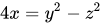
A four-sided plane figure is a quadrilateral or quadrangle, sometimes also called a tetragon. It can be further classified as a rectangle or oblong, kite, rhombus, and square.
Four is the highest degree general polynomial equation for which there is a solution in radicals.[7]
Four is the only square number where is a prime number.


The four-color theorem states that a planar graph (or, equivalently, a flat map of two-dimensional regions such as countries) can be colored using four colors, so that adjacent vertices (or regions) are always different colors.[8] Three colors are not, in general, sufficient to guarantee this.[9] The largest planar complete graph has four vertices.[10]
A solid figure with four faces as well as four vertices is a tetrahedron, which is the smallest possible number of faces and vertices a polyhedron can have.[11] The regular tetrahedron, also called a 3-simplex, is the simplest Platonic solid.[12] It has four regular triangles as faces that are themselves at dual positions with the vertices of another tetrahedron.[13]
The smallest non-cyclic group has four elements; it is the Klein four-group.[14] An alternating groups are not simple for values ≤ .

There are four Hopf fibrations of hyperspheres:
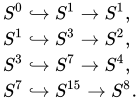
They are defined as locally trivial fibrations that map for values of (aside from the trivial fibration mapping between two points and a circle).[15]


In Knuth's up-arrow notation, , and so forth, for any number of up arrows.[16]

There are four dimensions in the theory of Minkowski space, three of space and the one being time.
List of basic calculations
[edit]| Multiplication | 1 | 2 | 3 | 4 | 5 | 6 | 7 | 8 | 9 | 10 | 11 | 12 | 13 | 14 | 15 | 16 | 17 | 18 | 19 | 20 | 21 | 22 | 23 | 24 | 25 | 50 | 100 | 1000 |
|---|---|---|---|---|---|---|---|---|---|---|---|---|---|---|---|---|---|---|---|---|---|---|---|---|---|---|---|---|
| 4 × x | 4 | 8 | 12 | 16 | 20 | 24 | 28 | 32 | 36 | 40 | 44 | 48 | 52 | 56 | 60 | 64 | 68 | 72 | 76 | 80 | 84 | 88 | 92 | 96 | 100 | 200 | 400 | 4000 |
| Division | 1 | 2 | 3 | 4 | 5 | 6 | 7 | 8 | 9 | 10 | 11 | 12 | 13 | 14 | 15 | 16 |
|---|---|---|---|---|---|---|---|---|---|---|---|---|---|---|---|---|
| 4 ÷ x | 4 | 2 | 1.3 | 1 | 0.8 | 0.6 | 0.571428 | 0.5 | 0.4 | 0.4 | 0.36 | 0.3 | 0.307692 | 0.285714 | 0.26 | 0.25 |
| x ÷ 4 | 0.25 | 0.5 | 0.75 | 1 | 1.25 | 1.5 | 1.75 | 2 | 2.25 | 2.5 | 2.75 | 3 | 3.25 | 3.5 | 3.75 | 4 |
| Exponentiation | 1 | 2 | 3 | 4 | 5 | 6 | 7 | 8 | 9 | 10 | 11 | 12 | 13 | 14 | 15 | 16 |
|---|---|---|---|---|---|---|---|---|---|---|---|---|---|---|---|---|
| 4x | 4 | 16 | 64 | 256 | 1024 | 4096 | 16384 | 65536 | 262144 | 1048576 | 4194304 | 16777216 | 67108864 | 268435456 | 1073741824 | 4294967296 |
| x4 | 1 | 16 | 81 | 256 | 625 | 1296 | 2401 | 4096 | 6561 | 10000 | 14641 | 20736 | 28561 | 38416 | 50625 | 65536 |
In culture
[edit]- Four is the sacred number of the Zia, an indigenous tribe located in the U.S. state of New Mexico.[17]
- Superstition about the number four is most common in East Asian nations, where it is a homonym for "death" in many languages.[18]
In technology
[edit]- In internet slang, "4" can replace the word "for" (as "four" and "for" are pronounced similarly). For example, messaging "4 u" instead of "for you" when talking to someone.
- In Leetspeak, "4" may be used to replace the letter "A".
References
[edit]- ↑ Heller, Steven (January 3, 2017). Graphic Design Rants and Raves Bon Mots on Persuasion, Entertainment, Education, Culture, and Practice. Allworth Press. ISBN 9781621535393.
- ↑ Ifrah, Georges (1998). The Universal History of Numbers: From Prehistory to the Invention of the Computer. Translated by Bellos, David; et al. London: The Harvill Press. p. 394, Fig. 24.64.
- ↑ "Seven Segment Displays (7-Segment)". Electronics Hub. 2019-04-22. Archived from the original on 28 July 2020. Retrieved 2020-07-28.
- ↑ "Battle of the MICR Fonts: Which Is Better, E13B or CMC7? - Digital Check". Digital Check. 2017-02-02. Archived from the original on 3 August 2020. Retrieved 2020-07-28.
- ↑ Spencer, Joel (1996), "Four Squares with Few Squares", in Chudnovsky, David V.; Chudnovsky, Gregory V.; Nathanson, Melvyn B. (eds.), Number Theory: New York Seminar 1991–1995, New York, NY: Springer US, pp. 295–297, doi:10.1007/978-1-4612-2418-1_22, ISBN 978-1-4612-2418-1
- ↑ Peterson, Ivars (2002). Mathematical Treks: From Surreal Numbers to Magic Circles. MAA. p. 95. ISBN 978-0-88385-537-9.
7 is an example of an integer that can't be written as the sum of three squares.
- ↑ Bajnok, Béla (2013-05-13). An Invitation to Abstract Mathematics. Springer Science & Business Media. ISBN 978-1-4614-6636-9.
There is no algebraic formula for the roots of the general polynomial of degrees 5 or higher.
- ↑ Bunch, Bryan (2000). The Kingdom of Infinite Number. New York: W. H. Freeman & Company. p. 48.
- ↑ Ben-Menahem, Ari (2009-03-06). Historical Encyclopedia of Natural and Mathematical Sciences. Springer Science & Business Media. p. 2147. ISBN 978-3-540-68831-0.
(i.e. That there are maps for which three colors are not sufficient)
- ↑ Molitierno, Jason J. (2016-04-19). Applications of Combinatorial Matrix Theory to Laplacian Matrices of Graphs. CRC Press. p. 197. ISBN 978-1-4398-6339-8.
... The complete graph on the largest number of vertices that is planar is K4 and that a(K4) equals 4.
- ↑ Grossnickle, Foster Earl; Reckzeh, John (1968). Discovering Meanings in Elementary School Mathematics. Holt, Rinehart and Winston. p. 337. ISBN 9780030676451.
...the smallest possible number of faces that a polyhedron may have is four
- ↑ Grossnickle, Foster Earl; Reckzeh, John (1968). Discovering Meanings in Elementary School Mathematics. Holt, Rinehart and Winston. p. 337. ISBN 9780030676451.
...face of the platonic solid. The simplest of these shapes is the tetrahedron...
- ↑ Hilbert, David; Cohn-Vossen, Stephan (1999). Geometry and the Imagination. American Mathematical Soc. p. 143. ISBN 978-0-8218-1998-2.
...the tetrahedron plays an anomalous role in that it is self-dual, whereas the four remaining polyhedra are mutually dual in pairs...
- ↑ Horne, Jeremy (2017-05-19). Philosophical Perceptions on Logic and Order. IGI Global. p. 299. ISBN 978-1-5225-2444-1. Archived from the original on 31 October 2022. Retrieved 31 October 2022.
The Klein four-group is the smallest noncyclic group,...
- ↑ Shokurov, A.V. (2002). "Hopf fibration". In Michiel Hazewinkel (ed.). Encyclopedia of Mathematics. Helsinki: European Mathematical Society. ISBN 1402006098. OCLC 1013220521. Archived from the original on 1 May 2023. Retrieved 2023-04-30.
- ↑ Hodges, Andrew (2008-05-17). One to Nine: The Inner Life of Numbers. W. W. Norton & Company. p. 249. ISBN 978-0-393-06863-4.
2 ↑↑ ... ↑↑ 2 is always 4
- ↑ Bulletin - State Department of Education. Department of Education. 1955. p. 151.
Four was a sacred number of Zia
- ↑ Lachenmeyer, Nathaniel (2005). 13: The Story of the World's Most Notorious Superstition. Penguin Group (USA) Incorporated. p. 187. ISBN 978-0-452-28496-8.
In Chinese, Japanese, and Korean, the word for four is, unfortunately, an exact homonym for death
- Wells, D. The Penguin Dictionary of Curious and Interesting Numbers London: Penguin Group. (1987): 55–58
External links
[edit]- Marijn.Org on Why is everything four?
- A few thoughts on the number four, by Penelope Merritt at samuel-beckett.net
- The Number 4
- The Positive Integer 4
- Prime curiosities: 4
| |||||||||
| |||||||||
| |||||||||
| |||||||||
| ||||
|---|---|---|---|---|
| Cardinal | five | |||
| Ordinal | 5th (fifth) | |||
| Numeral system | quinary | |||
| Factorization | prime | |||
| Prime | 3rd | |||
| Divisors | 1, 5 | |||
| Greek numeral | Ε´ | |||
| Roman numeral | V, v | |||
| Greek prefix | penta-/pent- | |||
| Latin prefix | quinque-/quinqu-/quint- | |||
| Binary | 1012 | |||
| Ternary | 123 | |||
| Senary | 56 | |||
| Octal | 58 | |||
| Duodecimal | 512 | |||
| Hexadecimal | 516 | |||
| Greek | ε (or Ε) | |||
| Arabic, Kurdish | ٥ | |||
| Persian, Sindhi, Urdu | ۵ | |||
| Ge'ez | ፭ | |||
| Bengali | ৫ | |||
| Kannada | ೫ | |||
| Punjabi | ੫ | |||
| Chinese numeral | 五 | |||
| Armenian | Ե | |||
| Devanāgarī | ५ | |||
| Hebrew | ה | |||
| Khmer | ៥ | |||
| Telugu | ౫ | |||
| Malayalam | ൫ | |||
| Tamil | ௫ | |||
| Thai | ๕ | |||
| Babylonian numeral | 𒐙 | |||
| Egyptian hieroglyph, Chinese counting rod | ||||| | |||
| Maya numerals | 𝋥 | |||
| Morse code | ..... | |||
| ASCII value | ENQ | |||
| Santali | ᱕ | |||
5 (five) is a number, numeral and digit. It is the natural number, and cardinal number, following 4 and preceding 6, and is a prime number.
Humans, and many other animals, have 5 digits on their limbs.
Mathematics
[edit]
5 is a Fermat prime, a Mersenne prime exponent,[1] as well as a Fibonacci number. 5 is the first congruent number, as well as the length of the hypotenuse of the smallest integer-sided right triangle, making part of the smallest Pythagorean triple (3, 4, 5).[2]
5 is the first safe prime[3] and the first good prime.[4] 11 forms the first pair of sexy primes with 5.[5] 5 is the second Fermat prime, of a total of five known Fermat primes.[6] 5 is also the first of three known Wilson primes (5, 13, 563).[7]
Geometry
[edit]A shape with five sides is called a pentagon. The equilateral pentagon is the first regular polygon that does not tile the plane with copies of itself. The pentagon solid has the largest face of any of the five regular three-dimensional regular Platonic solids.
A conic is determined using five points in the same way that two points are needed to determine a line.[8] A pentagram, or five-pointed polygram, is a star polygon constructed by connecting some non-adjacent vertices of a regular pentagon as self-intersecting edges.[9] The internal geometry of the pentagon and pentagram (represented by its Schläfli symbol {5/2}) appears prominently in Penrose tilings. Pentagrams are facets inside Kepler–Poinsot star polyhedra and Schläfli–Hess star polychora.
There are five regular Platonic solids the tetrahedron, the cube, the octahedron, the dodecahedron, and the icosahedron.[10]
The plane contains a total of five Bravais lattices, or arrays of points defined by discrete translation operations. Uniform tilings of the plane, are generated from combinations of only five regular polygons.[11]
Five-fold symmetry is associated with the golden ratio . In a regular pentagram, intersections of diagonals divide one another in the golden ratio.[12]

Higher dimensional geometry
[edit]A hypertetrahedron, or 5-cell, is the 4 dimensional analogue of the tetrahedron. It has five vertices. Its orthographic projection is homomorphic to the group K5.[13]: p.120
There are five fundamental mirror symmetry point group families in 4-dimensions. There are also 5 compact hyperbolic Coxeter groups, or 4-prisms, of rank 5, each generating uniform honeycombs in hyperbolic 4-space as permutations of rings of the Coxeter diagrams.[14]

Arithmetic
[edit]
5 is the value of the central cell of the first non-trivial normal magic square, called the Luoshu square. All integers can be expressed as the sum of five non-zero squares.[15][16] There are five countably infinite Ramsey classes of permutations.[17]: p.4 5 is conjectured to be the only odd, untouchable number; if this is the case, then five will be the only odd prime number that is not the base of an aliquot tree.[18]


 ).
). Every odd number greater than five is conjectured to be expressible as the sum of three prime numbers; Helfgott has provided a proof of this[19] (also known as the odd Goldbach conjecture) that is already widely acknowledged by mathematicians as it still undergoes peer-review. On the other hand, every odd number greater than one is the sum of at most five prime numbers (as a lower limit).[20]
Group theory
[edit]In graph theory, all graphs with four or fewer vertices are planar, however, there is a graph with five vertices that is not: K5, the complete graph with five vertices. By Kuratowski's theorem, a finite graph is planar if and only if it does not contain a subgraph that is a subdivision of K5, or K3,3, the utility graph.[21]
There are five complex exceptional Lie algebras. The five Mathieu groups constitute the first generation in the happy family of sporadic groups. These are also the first five sporadic groups to have been described.[22]: p.54 A centralizer of an element of order 5 inside the largest sporadic group arises from the product between Harada–Norton sporadic group and a group of order 5.[23][24]


List of basic calculations
[edit]| Multiplication | 1 | 2 | 3 | 4 | 5 | 6 | 7 | 8 | 9 | 10 | 11 | 12 | 13 | 14 | 15 | 16 | 17 | 18 | 19 | 20 |
|---|---|---|---|---|---|---|---|---|---|---|---|---|---|---|---|---|---|---|---|---|
| 5 × x | 5 | 10 | 15 | 20 | 25 | 30 | 35 | 40 | 45 | 50 | 55 | 60 | 65 | 70 | 75 | 80 | 85 | 90 | 95 | 100 |
| Division | 1 | 2 | 3 | 4 | 5 | 6 | 7 | 8 | 9 | 10 | 11 | 12 | 13 | 14 | 15 |
|---|---|---|---|---|---|---|---|---|---|---|---|---|---|---|---|
| 5 ÷ x | 5 | 2.5 | 1.6 | 1.25 | 1 | 0.83 | 0.714285 | 0.625 | 0.5 | 0.5 | 0.45 | 0.416 | 0.384615 | 0.3571428 | 0.3 |
| x ÷ 5 | 0.2 | 0.4 | 0.6 | 0.8 | 1.2 | 1.4 | 1.6 | 1.8 | 2 | 2.2 | 2.4 | 2.6 | 2.8 | 3 |
| Exponentiation | 1 | 2 | 3 | 4 | 5 | 6 | 7 | 8 | 9 | 10 | 11 | 12 | 13 | 14 | 15 |
|---|---|---|---|---|---|---|---|---|---|---|---|---|---|---|---|
| 5x | 5 | 25 | 125 | 625 | 3125 | 15625 | 78125 | 390625 | 1953125 | 9765625 | 48828125 | 244140625 | 1220703125 | 6103515625 | 30517578125 |
| x5 | 1 | 32 | 243 | 1024 | 7776 | 16807 | 32768 | 59049 | 100000 | 161051 | 248832 | 371293 | 537824 | 759375 |
Evolution of the Arabic digit
[edit]
The evolution of the modern Western digit for the numeral for five is traced back to the Indian system of numerals, where on some earlier versions, the numeral bore resemblance to variations of the number four, rather than "5" (as it is represented today). The Kushana and Gupta empires in what is now India had among themselves several forms that bear no resemblance to the modern digit. Later on, Arabic traditions transformed the digit in several ways, producing forms that were still similar to the numeral for four, with similarities to the numeral for three; yet, still unlike the modern five.[25] It was from those digits that Europeans finally came up with the modern 5 (represented in writings by Dürer, for example).

While the shape of the character for the digit 5 has an ascender in most modern typefaces, in typefaces with text figures the glyph usually has a descender, as, for example, in  .
.
On the seven-segment display of a calculator and digital clock, it is often represented by five segments at four successive turns from top to bottom, rotating counterclockwise first, then clockwise, and vice versa. It is one of three numbers, along with 4 and 6, where the number of segments matches the number. This makes it often indistinguishable from the letter S. Higher segment displays may sometimes may make use of a diagonal for one of the two.
Other fields
[edit]In Basque, bost, "5", also means "a lot".[26]
Religion
[edit]Judaism
[edit]Five is according to Maharal of Prague the number defined as the center point which unifies four extremes.[citation needed]
Islam
[edit]The Five Pillars of Islam.[27] The five-pointed simple star ☆ is one of the five used in Islamic Girih tiles.[28]
See also
[edit]References
[edit]- ↑ Sloane, N. J. A. (ed.). "Sequence A000043 (mersenne prime exponents)". The On-Line Encyclopedia of Integer Sequences. OEIS Foundation.
- ↑ Sloane, N. J. A. (ed.). "Sequence A003273 (Congruent numbers)". The On-Line Encyclopedia of Integer Sequences. OEIS Foundation. Retrieved 2016-06-01.
- ↑ Sloane, N. J. A. (ed.). "Sequence A005385 (Safe primes p: (p-1)/2 is also prime)". The On-Line Encyclopedia of Integer Sequences. OEIS Foundation. Retrieved 2023-02-14.
- ↑ Sloane, N. J. A. (ed.). "Sequence A028388 (Good primes)". The On-Line Encyclopedia of Integer Sequences. OEIS Foundation. Retrieved 2016-06-01.
- ↑ Sloane, N. J. A. (ed.). "Sequence A023201 (Primes p such that p + 6 is also prime. (Lesser of a pair of sexy primes.))". The On-Line Encyclopedia of Integer Sequences. OEIS Foundation. Retrieved 2023-01-14.
- ↑ Sloane, N. J. A. (ed.). "Sequence A019434 (Fermat primes)". The On-Line Encyclopedia of Integer Sequences. OEIS Foundation. Retrieved 2022-07-21.
- ↑ Sloane, N. J. A. (ed.). "Sequence A007540 (Wilson primes: primes p such that (p-1)! is congruent -1 (mod p^2).)". The On-Line Encyclopedia of Integer Sequences. OEIS Foundation. Retrieved 2023-09-06.
- ↑ Dixon, A. C. (March 1908). "The Conic through Five Given Points". The Mathematical Gazette. 4 (70). The Mathematical Association: 228–230. doi:10.2307/3605147. JSTOR 3605147. S2CID 125356690.
- ↑ Sloane, N. J. A. (ed.). "Sequence A307681 (Difference between the number of sides and the number of diagonals of a convex n-gon.)". The On-Line Encyclopedia of Integer Sequences. OEIS Foundation.
- ↑ Bryan Bunch, The Kingdom of Infinite Number. New York: W. H. Freeman & Company (2000): 61
- ↑ Grünbaum, Branko; Shepard, Geoffrey (November 1977). "Tilings by Regular Polygons" (PDF). Mathematics Magazine. 50 (5). Taylor & Francis, Ltd.: 227–236. doi:10.2307/2689529. JSTOR 2689529. S2CID 123776612. Zbl 0385.51006. Archived from the original (PDF) on 2016-03-03. Retrieved 2023-01-18.
- ↑ Coxeter, H. S. M. (1969). "The golden section and phyllotaxis". Introduction to Geometry (2nd ed.). New York: John Wiley & Sons. ISBN 978-0-471-50458-0.
- ↑ H. S. M. Coxeter (1973). Regular Polytopes (3rd ed.). New York: Dover Publications, Inc. pp. 1–368. ISBN 978-0-486-61480-9.
- ↑ McMullen, Peter; Schulte, Egon (2002). Abstract Regular Polytopes. Encyclopedia of Mathematics and its Applications. Vol. 92. Cambridge: Cambridge University Press. pp. 162–164. doi:10.1017/CBO9780511546686. ISBN 0-521-81496-0. MR 1965665. S2CID 115688843.
- ↑ Niven, Ivan; Zuckerman, Herbert S.; Montgomery, Hugh L. (1980). An Introduction to the Theory of Numbers (5th ed.). New York, NY: John Wiley. pp. 144, 145. ISBN 978-0-19-853171-5.
- ↑ Sloane, N. J. A. (ed.). "Sequence A047701 (All positive numbers that are not the sum of 5 nonzero squares.)". The On-Line Encyclopedia of Integer Sequences. OEIS Foundation. Retrieved 2023-09-20.
- Only twelve integers up to 33 cannot be expressed as the sum of five non-zero squares: {1, 2, 3, 4, 6, 7, 9, 10, 12, 15, 18, 33} where 2, 3 and 7 are the only such primes without an expression.
- ↑ Böttcher, Julia; Foniok, Jan (2013). "Ramsey Properties of Permutations". The Electronic Journal of Combinatorics. 20 (1): P2. arXiv:1103.5686v2. doi:10.37236/2978. S2CID 17184541. Zbl 1267.05284.
- ↑ Pomerance, Carl; Yang, Hee-Sung (14 June 2012). "On Untouchable Numbers and Related Problems" (PDF). math.dartmouth.edu. Dartmouth College: 1. S2CID 30344483. 2010 Mathematics Subject Classification. 11A25, 11Y70, 11Y16.
- ↑ Helfgott, Harald Andres (2014). "The ternary Goldbach problem" (PDF). In Jang, Sun Young (ed.). Seoul International Congress of Mathematicians Proceedings. Vol. 2. Seoul, KOR: Kyung Moon SA. pp. 391–418. ISBN 978-89-6105-805-6. OCLC 913564239.
- ↑ Tao, Terence (March 2014). "Every odd number greater than 1 has a representation is the sum of at most five primes" (PDF). Mathematics of Computation. 83 (286): 997–1038. doi:10.1090/S0025-5718-2013-02733-0. MR 3143702. S2CID 2618958.
- ↑ Burnstein, Michael (1978). "Kuratowski-Pontrjagin theorem on planar graphs". Journal of Combinatorial Theory. Series B. 24 (2): 228–232. doi:10.1016/0095-8956(78)90024-2.
- ↑ Robert L. Griess, Jr. (1998). Twelve Sporadic Groups. Springer Monographs in Mathematics. Berlin: Springer-Verlag. pp. 1−169. doi:10.1007/978-3-662-03516-0. ISBN 978-3-540-62778-4. MR 1707296. S2CID 116914446. Zbl 0908.20007.
- ↑ Lux, Klaus; Noeske, Felix; Ryba, Alexander J. E. (2008). "The 5-modular characters of the sporadic simple Harada–Norton group HN and its automorphism group HN.2". Journal of Algebra. 319 (1). Amsterdam: Elsevier: 320–335. doi:10.1016/j.jalgebra.2007.03.046. MR 2378074. S2CID 120706746. Zbl 1135.20007.
- ↑ Wilson, Robert A. (2009). "The odd local subgroups of the Monster". Journal of Australian Mathematical Society. 44 (1). Cambridge: Cambridge University Press: 12–13. doi:10.1017/S1446788700031323. MR 0914399. S2CID 123184319. Zbl 0636.20014.
- ↑ Georges Ifrah, The Universal History of Numbers: From Prehistory to the Invention of the Computer transl. David Bellos et al. London: The Harvill Press (1998): 394, Fig. 24.65
- ↑ "bost". Orotariko Euskal Hiztegia (in Spanish). Retrieved 25 September 2025.
Mucho(s). "Bost cinco, [...] en la propiedad de la lengua, fuera del sentido recto significa mucho y muchos, como bost bider egin degu, hartas veces, muchas veces lo hemos hecho" Lar.
- ↑ "PBS – Islam: Empire of Faith – Faith – Five Pillars". www.pbs.org. Retrieved 2020-08-03.
- ↑ Sarhangi, Reza (2012). "Interlocking Star Polygons in Persian Architecture: The Special Case of the Decagram in Mosaic Designs" (PDF). Nexus Network Journal. 14 (2): 350. doi:10.1007/s00004-012-0117-5. S2CID 124558613.
Further reading
[edit]- Wells, D. (1987). The Penguin Dictionary of Curious and Interesting Numbers. London, UK: Penguin Group. pp. 58–67.
External links
[edit]- Prime curiosities: 5
- Media related to Nasdn2/Numbers at Wikimedia Commons
| |||||||||
| |||||||||
| |||||||||
| |||||||||
Template:Suppress categories Template:Suppress categories Template:Suppress categories Template:Suppress categories Template:Suppress categories