


User:Marburns/sandbox


This mathematical constant is sometimes called the MRB constant[1][2][3][4][5] or MRB..[6] MRB stands for Marvin Ray Burns. Being a sum of irrational numbers its irrationally remains an open problem.[7]
The numerical value of the constant, truncated to 6 decimal places, is
Definition
[edit]
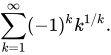
The constant is related to the following divergent series:
Its partial sums
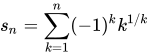
are bounded so that their limit points form an interval [−0.812140…,0.187859…] of length 1..[8] The upper limit point 0.187859… is what is sometimes called the MRB constant. [9] The constant can be explicitly defined by the following infinite sums: [10] [11]

There is no known closed-form expression of this constant.[12]
History
[edit]Marvin Ray Burns published his discovery of the constant in 1999.[13] The discovery is a result of a "math binge" that started in the spring of 1994.[14] Before verifying with colleague Simon Plouffe that such a constant had not already been discovered or at least not widely published, Burns called the constant "rc" for root constant.[15] At Plouffe's suggestion, the constant was renamed Marvin Ray Burns's Constant, and then shortened to "MRB constant" in 1999.[16] Since then it has been added to tables of constants in a few countries, including Turkey,[17] Iran,[18] Germany.[19] and the United States.[20]
References
[edit]- ↑ Weisstein, Eric W. ""MRB Constant". MathWorld. MathWorld--A Wolfram Web Resource. Retrieved 12 January 2015.
- ↑ MATHAR, RICHARD J (2009). "NUMERICAL EVALUATION OF THE OSCILLATORY INTEGRAL OVER exp(iπx) x^*1/x) BETWEEN 1 AND INFINITY" (PDF). Cornell University. arXiv:0912.3844v3. Retrieved 12 January 2015.
- ↑ Crandall, Richard. "Unified algorithms for polylogarithm, L-series, and zeta variants" (PDF). marvinrayburns.com. PSI Press. Retrieved 13 January 2015.
- ↑ (sequence A160755 in the OEIS) and (sequence A173273 in the OEIS)
- ↑ Fiorentini, Mauro. "MRB (costante)". bitman.name (in Italian). Mauro Fiorentini. Retrieved 14 January 2015.
- ↑ Finch, Steven R. "Irrationality of the MRB constsnt". marvinrayburns.com. Marvin Burns. Retrieved 13 January 2015.
- ↑ Finch, Steven R. "Irrationality of the MRB constsnt". marvinrayburns.com. Marvin Burns. Retrieved 13 January 2015.
- ↑ Weisstein, Eric W. ""MRB Constant". MathWorld. MathWorld--A Wolfram Web Resource. Retrieved 12 January 2015.
- ↑ Weisstein, Eric W. ""MRB Constant". MathWorld. MathWorld--A Wolfram Web Resource. Retrieved 12 January 2015.
- ↑ Finch, Steven R. (2003). Mathematical Constants. Cambridge, England: Cambridge University Press. p. 450. ISBN 0-521-81805-2.
- ↑ Weisstein, Eric W. "MRB Constant". MathWorld.
- ↑ Finch, Steven R. (2003). Mathematical Constants. Cambridge, England: Cambridge University Press. p. 450. ISBN 0-521-81805-2.
- ↑ Burns, Marvin. "mrburns". plouffe.fr. SImeon Plouffe. Retrieved 12 January 2015.
- ↑ Burns, Marvin R. (2002-04-12). "Captivity's Captor: Now is the Time for the Chorus of Conversion". Indiana University. Retrieved 2009-05-05.
- ↑ Burns, Marvin R. (1999-01-23). "RC". math2.org. Retrieved 2009-05-05.
{{cite web}}: External link in|publisher= - ↑ Plouffe, Simon (1999-11-20). "Tables of Constants" (PDF). Laboratoire de combinatoire et d'informatique mathématique. Retrieved 2009-05-05.
{{cite web}}: External link in|publisher= - ↑ "Matematıksel Sabıtler" (in Turkish). Türk Biyofizik Derneği. Retrieved 2015-01-13.
{{cite web}}: External link in|publisher= - ↑ "Mathematical Constants". Iran Civil Center. Archived from the original on 2008-11-21. Retrieved 2015-01-13.
{{cite web}}: External link in|publisher= - ↑ "Etymologie CA Kanada Zahlen" (in German). etymologie.info. Retrieved 2015-01-13.
{{cite web}}: External link in|publisher= - ↑ Weisstein, Eric W. "MiscellaneousConstants". mathworld.wolfram.com. Wolfram Research. Retrieved 14 January 2015.
External links
[edit]
Category:Mathematical constants Category:Number theory
The MRB constant, named after Marvin Ray Burns, is a mathematical constant for which no closed-form expression is known. It is not known whether the MRB constant is algebraic, transcendental, or even irrational.
The numerical value of MRB constant, truncated to 6 decimal places, is
Definition
[edit]The MRB constant is related to the following divergent series:
Its partial sums
are bounded so that their limit points form an interval [−0.812140…,0.187859…] of length 1. The upper limit point 0.187859… is what is known as the MRB constant.[1][2][3][4][5][6][7]
The MRB constant can be explicitly defined by the following infinite sums:[8]
There is no known closed-form expression of the MRB constant.[9]
History
[edit]History Marvin Ray Burns published his discovery of the constant in 1999.[10] The discovery is a result of a "math binge" that started in the spring of 1994.[11] Before verifying with colleague Simon Plouffe that such a constant had not already been discovered or at least not widely published, Burns called the constant "rc" for root constant.[12] At Plouffe's suggestion, the constant was renamed Marvin Ray Burns's Constant, and then shortened to "MRB constant" in 1999.[13] Since then it has been added to tables and lists of constants in a few countries, including Turkey,[14] Iran,[15] Germany.[16] , the United States.[17] and Italy[18]
References
[edit]- ↑ Weisstein, Eric W. ""MRB Constant". MathWorld. MathWorld--A Wolfram Web Resource. Retrieved 12 January 2015.
- ↑ MATHAR, RICHARD J (2009). "NUMERICAL EVALUATION OF THE OSCILLATORY INTEGRAL OVER exp(iπx) x^*1/x) BETWEEN 1 AND INFINITY" (PDF). Cornell University. arXiv:0912.3844v3. Retrieved 12 January 2015.
- ↑ Crandall, Richard. "Unified algorithms for polylogarithm, L-series, and zeta variants" (PDF). PSI Press. Archived from the original (PDF) on 2013-04-30. Retrieved 16 January 2015.
- ↑ (sequence A037077 in the OEIS)
- ↑ (sequence A160755 in the OEIS)
- ↑ (sequence A173273 in the OEIS)
- ↑ Fiorentini, Mauro. "MRB (costante)". bitman.name (in Italian). Mauro Fiorentini. Retrieved 14 January 2015.
- ↑ Weisstein, Eric W. "MRB Constant". MathWorld.
- ↑ Finch, Steven R. (2003). Mathematical Constants. Cambridge, England: Cambridge University Press. p. 450. ISBN 0-521-81805-2.
- ↑ Burns, Marvin. "mrburns". plouffe.fr. SImeon Plouffe. Retrieved 12 January 2015.
- ↑ Burns, Marvin R. (2002-04-12). "Captivity's Captor: Now is the Time for the Chorus of Conversion". Indiana University. Retrieved 2009-05-05.
- ↑ Burns, Marvin R. (1999-01-23). "RC". math2.org. Retrieved 2009-05-05.
{{cite web}}: External link in|publisher= - ↑ Plouffe, Simon (1999-11-20). "Tables of Constants" (PDF). Laboratoire de combinatoire et d'informatique mathématique. Retrieved 2009-05-05.
{{cite web}}: External link in|publisher= - ↑ "Matematıksel Sabıtler" (in Turkish). Türk Biyofizik Derneği. Retrieved 2015-01-13.
{{cite web}}: External link in|publisher= - ↑ "Mathematical Constants". Iran Civil Center. Archived from the original on 2008-11-21. Retrieved 2015-01-13.
{{cite web}}: External link in|publisher= - ↑ "Etymologie CA Kanada Zahlen" (in German). etymologie.info. Retrieved 2015-01-13.
{{cite web}}: External link in|publisher= - ↑ Weisstein, Eric W. "MiscellaneousConstants". mathworld.wolfram.com. Wolfram Research. Retrieved 14 January 2015.
- ↑ Sýkora, Stanislav. "Mathematical Constants". ebyte.it. ebyte.it. Retrieved 1 February 2015.
External links
[edit]
Iterated exponentials are an example of an iterated function system based on . Such systems have induced some interesting mathematical constants and interesting fractal properties based on its generalization to the complex plane.[1]

Inverse
[edit]In fact, does have an inverse

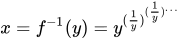
which is well-defined for
![{\displaystyle y\in [({\frac {1}{e}})^{\frac {1}{e}},e^{e}]}](https://wikimedia.org/api/rest_v1/media/math/render/svg/8f7212e387348e752fdaf275d427c46ac29f2c04)
This has induced interest in the function , which has similar limiting properties to . [2]

Convergence
[edit]By an old result of Euler, repeated exponentiation convergence for real values inbetween and .[3]


Calculation of Iterated Exponential
[edit]In certain situations, one may calculate the iterated exponential, and certain constants remain of mathematical interest.
Connection to Lambert's Function
[edit]If one defines

for such where such a process converges,

Then actually has a closed form expression in terms of a function known as Lambert's function which is defined implicitly via the following equation:

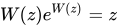
Namely, that
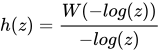
This can be seen by inputting this definition of into the other equation that satisfies, . [4]

Iteration on the Complex Plane
[edit]The function may also be extended to the complex plane, where such a map tends to display interesting fractal properties.[5]
Of particular interest is evaluation of the constant

Which does indeed converge [6] and has been evaluated as

<ref>Galidakis, I. N. (2004). On an application of Lambert's W function to infinite exponentials. Complex Variables, Theory and Application: An International Journal, 49(11), 759-780.</math>
Category:Mathematical constants
Category:Number theory
- ↑ Finch, S. R. (2003). Mathematical constants. Cambridge university press. pp.448-<452/ref>
Background
Analytic Properties of Iterated Exponentials
Minimum and Injectivity
We note that is concave up with minimum or </math>=(0.3678794412...,0.6922006276...)</math> <ref>De Villiers, J. M., & Robinson, P. N. (1986). The interval of convergence and limiting functions of a hyperpower sequence. American Mathematical Monthly, 13-23. - ↑ De Villiers, J. M., & Robinson, P. N. (1986). The interval of convergence and limiting functions of a hyperpower sequence. American Mathematical Monthly, 13-23.
- ↑ L. Euler, De formulis exponentialibus replicatis, Leonhardi Euleri Opera Omnia, Ser. 1, Opera Mathematica 15 (1927) 268-297
- ↑ Corless, R. M., Gonnet, G. H., Hare, D. E., Jeffrey, D. J., & Knuth, D. E. (1996). On the Lambert W function. Advances in Computational mathematics, 5(1), 329-359.
- ↑ Baker, I. N., & Rippon, P. J. (1985). A note on complex iteration. American Mathematical Monthly, 501-504.
- ↑ Macintyre, A. J. (1966). Convergence of Failed to parse (syntax error): {\displaystyle 𝑖^{𝑖𝑖 \cdots}} . Proceedings of the American Mathematical Society, 17(1), 67.
