

User:Gabobaby/sandbox

yo, wussup?
Charge conjugation in particle physics
[edit]
Formalism
[edit]Consider an operation, , that transforms a particle into it's antiparticle

- .

Both states must be normalizable, so that

which implies that is unitary,
- .

By acting on the particle twice with the operator,
- ,

we see that and . Putting this all together, we see that


- ,

meaning that the charge conjugation operator is Hermitian and therefore a physically observable quantity.
Eigenvalues
[edit]For the eigenstates of charge conjugation,
- .
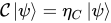
As with parity transformation, operating twice with is symmetric and must leave the original particle's state unchanged,

allowing for eigenvalues of , which is called the C-parity or charge parity of the particle.

Eigenstates
[edit]The above implies that and have exactly the same quantum charges, so only truly neutral systems —those where all quantum charges and magnetic moment are 0— are eigenstates of charge parity, that is, the photon and particle-antiparticle bound states: neutral pion, η, positronium... The neutron is not an eigenstate because it has a magnetic moment, and so does not have an associated C parity.


Multiparticle systems
[edit]For a system of free particles, the C parity is the product of C parities for each particle.
In a pair of bound bosons there is an additional component due to the orbital angular momentum. For example, in a bound state of two pions, π+ π− with an orbital angular momentum L, exchanging π+ and π− inverts the relative position vector, which is identical to a parity operation. Under this operation, the angular part of the spatial wave function contributes a phase factor of (−1)L, where L is the angular momentum quantum number associated with L.
- .

With a two-fermion system, two extra factors appear: one comes from the spin part of the wave function, and the second from the exchange of a fermion by its antifermion.

Bound states can be described with the spectroscopic notation 2S+1LJ (see term symbol), where S is the total spin quantum number, L the total orbital momentum quantum number and J the total angular momentum quantum number. Example: the positronium is a bound state electron-positron similar to an hydrogen atom. The parapositronium and ortopositronium correspond to the states 1S0 and 3S1.
- With S = 0 spins are anti-parallel, and with S = 1 they are parallel. This gives a multiplicity (2S+1) of 1 or 3, respectively
- The total orbital angular momentum quantum number is L = 0 (S, in spectroscopic notation)
- Total angular momentum quantum number is J = 0, 1
- C parity ηC = (−1)L + S = +1, −1, respectively. Since charge parity is preserved, annihilation of these states in photons (ηC(γ) = −1) must be:
1S0 → γ + γ 3S1 → γ + γ + γ ηC: +1 = (−1) × (−1) −1 = (−1) × (−1) × (−1)
Experimental tests of C-parity conservation
[edit]- : The neutral pion, , is observed to decay to two photons,γ+γ. We can infer that the pion therefore has , but each additional γ introduces a factor of -1 to the overall C parity of the pion. The decay to 3γ would violate C parity conservation. A search for this decay was conducted[1] using pions created in the reaction .




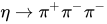
- annihilations[3]

References
[edit]- ↑ MacDonough, J. (1988). Phys. Review. D38: 2121.
{{cite journal}}: Missing or empty|title=(help); Unknown parameter|coauthors=ignored (|author=suggested) (help) - ↑ Gormley, M. (1968). "Experimental Test ofInvariance inFailed to parse (syntax error): {\displaystyle η→<mrow><msup><mrow>π</mrow><mrow>+</mrow></msup></mrow><mrow><msup><mrow>π</mrow><mrow>−</mrow></msup></mrow><mrow><msup><mrow>π</mrow><mrow>0</mrow></msup></mrow>}
". Phys. Rev. Lett. 21 (6): 402. doi:10.1103/PhysRevLett.21.402.
{{cite journal}}: Unknown parameter|coauthors=ignored (|author=suggested) (help) - ↑ Baltay, C (1965). "Test of Charge-Conjugation Invariance inFailed to parse (syntax error): {\displaystyle <mrow><mrow><mover><mrow>p</mrow><mrow>¯</mrow></mover></mrow></mrow>−p}
Annihilations at Rest". Phys. Rev. Lett. 15 (14): 591. doi:10.1103/PhysRevLett.15.591.
{{cite journal}}: Unknown parameter|coauthors=ignored (|author=suggested) (help)
