


Talk:Birthday problem
Add topic | Birthday problem was a Natural sciences good articles nominee, but did not meet the good article criteria at the time. There may be suggestions below for improving the article. Once these issues have been addressed, the article can be renominated. Editors may also seek a reassessment of the decision if they believe there was a mistake. | |||||||||
| ||||||||||
 | This article is rated B-class on Wikipedia's content assessment scale. It is of interest to the following WikiProjects: | ||||||||||||||||||||
| |||||||||||||||||||||


logarithms and combinations
[edit]I just noticed this, which I don't see in the article: —Tamfang (talk) 18:01, 28 March 2024 (UTC)

- So what? --Macrakis (talk) 20:37, 28 March 2024 (UTC)
- 364.25/365.25 is the probability that a given pair do not share a birthday. 253 is the number of pairs among 23 people. I never knew before why the threshold number is 23. —Tamfang (talk) 06:15, 29 March 2024 (UTC)
- So you're saying that this is more than a coincidence? --Macrakis (talk) 15:45, 29 March 2024 (UTC)
- 364.25/365.25 is the probability that a given pair do not share a birthday. 253 is the number of pairs among 23 people. I never knew before why the threshold number is 23. —Tamfang (talk) 06:15, 29 March 2024 (UTC)
- Much closer, but equally meaningless: 365*log(2) = 252.999. --Macrakis (talk) 21:17, 28 March 2024 (UTC)
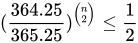
Or to put that another way, 23 is the smallest integer n such that . —Tamfang (talk) 00:03, 30 March 2024 (UTC)
- OK, I think I'm beginning to follow you here. Small detail: article says that leap years aren't taken into account, so it should be 364/365. --Macrakis (talk) 15:08, 1 April 2024 (UTC)
- Taking that further, the approximation n >= 0,5 + sqrt(0,25 + 2 * ln(2) * 365) mentioned in the article could then be improved by writing it as n >= 0,5 + sqrt(0,25 + 2 * ln(2) / ln (365/364)) Roelgrif (talk) 02:16, 11 January 2025 (UTC)
Not related to real life
[edit]There are no examples here of real life tests. Like going into a classroom or office and asking people. If this is just a numbers game it should be made clear at the start. 2A00:23C8:E414:1F01:6D85:5817:D045:A7F3 (talk) 23:16, 10 April 2025 (UTC)
- The article makes clear that it's about probability. The article also later mentions real-world probability due to unneven distribution. …/NemoThorx (💬 • 📜) 11:35, 4 August 2025 (UTC)
- Any real life test would be original research. The point is that it doesn't need a real life test, because it's a mathematical concept. All you need is a piece of chalk.User:Pedant (talk) User:Pedant (talk) 03:13, 10 January 2026 (UTC)
interactive widget
[edit]The birthday problem at a glance (365 equally likely birthdays)
| People in the group | Chance of a shared birthday |
|---|---|
| 5 | 2.7% |
| 10 | 11.7% |
| 23 | 50.7% |
| 30 | 70.6% |
| 50 | 97.0% |
| 70 | 99.9% |
With just 23 people, a shared birthday is already more likely than not. An interactive version of this demonstration is available with JavaScript enabled.
Hi all. I've been on an interactivity kick lately, given the possibilities opened by the new {{calculator}} template, and spent some time figuring out an interactive version of the birthday problem for the article. Disclosure: I used Claude Code to make the calculator syntax more manageable. This one's been through several versions at this point, trying to make it the most useful. I still have ambitions to replace the random dates with a random list of notable people (see this VPT thread), but it's usable as-is. What do we think? Worth adding? — Rhododendrites talk \\ 22:45, 30 July 2026 (UTC)