


Pythagorean quadruple

A Pythagorean quadruple is a tuple of integers a, b, c, and d, such that a2 + b2 + c2 = d2. They are solutions of a Diophantine equation and often only positive integer values are considered.[1] However, to provide a more complete geometric interpretation, the integer values can be allowed to be negative and zero (thus allowing Pythagorean triples to be included) with the only condition being that d > 0. In this setting, a Pythagorean quadruple (a, b, c, d) defines a cuboid with integer side lengths |a|, |b|, and |c|, whose space diagonal has integer length d; with this interpretation, Pythagorean quadruples are thus also called Pythagorean boxes.[2] In this article we will assume, unless otherwise stated, that the values of a Pythagorean quadruple are all positive integers.
Parametrization of primitive quadruples
[edit]A Pythagorean quadruple is called primitive if the greatest common divisor of its entries is 1. Every Pythagorean quadruple is an integer multiple of a primitive quadruple. The set of primitive Pythagorean quadruples for which a is odd can be generated by the formulas where m, n, p, q are non-negative integers with greatest common divisor 1 such that m + n + p + q is odd.[3][4][1] Thus, all primitive Pythagorean quadruples are characterized by the identity
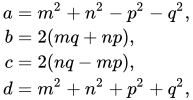

Alternate parametrization
[edit]All Pythagorean quadruples (including non-primitives, and with repetition, though a, b, and c do not appear in all possible orders) can be generated from two positive integers a and b as follows:
If a and b have different parity, let p be any factor of a2 + b2 such that p2 < a2 + b2. Then c = a2 + b2 − p2/2p and d = a2 + b2 + p2/2p. Note that p = d − c.
A similar method exists[5] for generating all Pythagorean quadruples for which a and b are both even. Let l = a/2 and m = b/2 and let n be a factor of l2 + m2 such that n2 < l2 + m2. Then c = l2 + m2 − n2/n and d = l2 + m2 + n2/n. This method generates all Pythagorean quadruples exactly once each when l and m run through all pairs of natural numbers and n runs through all permissible values for each pair.
No such method exists if both a and b are odd, in which case no solutions exist as can be seen by the parametrization in the previous section.
Properties
[edit]The largest number that always divides the product abcd is 12.[6] The quadruple with the minimal product is (1, 2, 2, 3).
Given a Pythagorean quadruple where then can be defined as the norm of the quadruple in that and is analogous to the hypotenuse of a Pythagorean triple.




Of the 3 terms within a primitive Pythagorean quadruple that are not the norm, exactly one will always be odd and the other two will be even. Consequently, the norm has to be odd.[7] [8]
Every odd positive number other than 1 and 5 can be the norm of a primitive Pythagorean quadruple such that are greater than zero and are coprime.[9] All primitive Pythagorean quadruples with the odd numbers as norms up to 29 except 1 and 5 are given in the table below.

Similar to a Pythagorean triple which generates a distinct right triangle, a Pythagorean quadruple will generate a distinct Heronian triangle.[10] If a, b, c, d is a Pythagorean quadruple with it will generate a Heronian triangle with sides x, y, z as follows: It will have a semiperimeter , an area and an inradius .



The exradii will be: The circumradius will be:


The ordered sequence of areas of this class of Heronian triangles can be found at (sequence A367737 in the OEIS).
Relationship with quaternions and rational orthogonal matrices
[edit]A primitive Pythagorean quadruple (a, b, c, d) parametrized by (m, n, p, q) corresponds to the first column of the matrix representation E(α) of conjugation α(⋅)α by the Hurwitz quaternion α = m + ni + pj + qk restricted to the subspace of quaternions spanned by i, j, k, which is given by where the columns are pairwise orthogonal and each has norm d. Furthermore, we have that 1/dE(α) belongs to the orthogonal group , and, in fact, all 3 × 3 orthogonal matrices with rational coefficients arise in this manner.[11]


Primitive Pythagorean quadruples with small norm
[edit]There are 31 primitive Pythagorean quadruples in which all entries are less than 30.
| ( | 1 | , | 2 | , | 2 | , | 3 | ) | ( | 2 | , | 10 | , | 11 | , | 15 | ) | ( | 4 | , | 13 | , | 16 | , | 21 | ) | ( | 2 | , | 10 | , | 25 | , | 27 | ) |
| ( | 2 | , | 3 | , | 6 | , | 7 | ) | ( | 1 | , | 12 | , | 12 | , | 17 | ) | ( | 8 | , | 11 | , | 16 | , | 21 | ) | ( | 2 | , | 14 | , | 23 | , | 27 | ) |
| ( | 1 | , | 4 | , | 8 | , | 9 | ) | ( | 8 | , | 9 | , | 12 | , | 17 | ) | ( | 3 | , | 6 | , | 22 | , | 23 | ) | ( | 7 | , | 14 | , | 22 | , | 27 | ) |
| ( | 4 | , | 4 | , | 7 | , | 9 | ) | ( | 1 | , | 6 | , | 18 | , | 19 | ) | ( | 3 | , | 14 | , | 18 | , | 23 | ) | ( | 10 | , | 10 | , | 23 | , | 27 | ) |
| ( | 2 | , | 6 | , | 9 | , | 11 | ) | ( | 6 | , | 6 | , | 17 | , | 19 | ) | ( | 6 | , | 13 | , | 18 | , | 23 | ) | ( | 3 | , | 16 | , | 24 | , | 29 | ) |
| ( | 6 | , | 6 | , | 7 | , | 11 | ) | ( | 6 | , | 10 | , | 15 | , | 19 | ) | ( | 9 | , | 12 | , | 20 | , | 25 | ) | ( | 11 | , | 12 | , | 24 | , | 29 | ) |
| ( | 3 | , | 4 | , | 12 | , | 13 | ) | ( | 4 | , | 5 | , | 20 | , | 21 | ) | ( | 12 | , | 15 | , | 16 | , | 25 | ) | ( | 12 | , | 16 | , | 21 | , | 29 | ) |
| ( | 2 | , | 5 | , | 14 | , | 15 | ) | ( | 4 | , | 8 | , | 19 | , | 21 | ) | ( | 2 | , | 7 | , | 26 | , | 27 | ) |
See also
[edit]- Beal conjecture
- Euler brick
- Euler's sum of powers conjecture
- Euler-Rodrigues formula for 3D rotations
- Fermat cubic
- Jacobi–Madden equation
- Lagrange's four-square theorem (every natural number can be represented as the sum of four integer squares)
- Legendre's three-square theorem (which natural numbers cannot be represented as the sum of three squares of integers)
- Prouhet–Tarry–Escott problem
- Quaternions and spatial rotation
- Taxicab number
References
[edit]- 1 2 R. Spira, The diophantine equation x2 + y2 + z2 = m2, Amer. Math. Monthly Vol. 69 (1962), No. 5, 360–365.
- ↑ R. A. Beauregard and E. R. Suryanarayan, Pythagorean boxes, Math. Magazine 74 (2001), 222–227.
- ↑ R.D. Carmichael, Diophantine Analysis, New York: John Wiley & Sons, 1915.
- ↑ L.E. Dickson, Some relations between the theory of numbers and other branches of mathematics, in Villat (Henri), ed., Conférence générale, Comptes rendus du Congrès international des mathématiciens, Strasbourg, Toulouse, 1921, pp. 41–56; reprint Nendeln/Liechtenstein: Kraus Reprint Limited, 1967; Collected Works 2, pp. 579–594.
- ↑ Sierpiński, Wacław, Pythagorean Triangles, Dover, 2003 (orig. 1962), p.102–103.
- ↑ MacHale, Des, and van den Bosch, Christian, "Generalising a result about Pythagorean triples", Mathematical Gazette 96, March 2012, pp. 91-96.
- ↑ Oliverio, P. "Self-Generating Pythagorean Quadruples and N-tuples" (PDF). Fib. Quart. 34, 98-101, 1996.
- ↑ "OEIS A097263". The On-Line Encyclopedia of Integer Sequences.
- ↑ "OEIS A005818". The On-Line Encyclopedia of Integer Sequences.
- ↑ "OEIS A367737". The On-Line Encyclopedia of Integer Sequences.
- ↑ J. Cremona, Letter to the Editor, Amer. Math. Monthly 94 (1987), 757–758.