Animals first appeared in the fossil record in the late Cryogenian period and diversified in the subsequent Ediacaran period in what is known as the Avalon explosion. Nearly all modern animal phyla first appeared in the fossil record as marine species during the Cambrian explosion, which began around 539million years ago (Mya), and most classes during the Ordovician radiation 485.4Mya. Common to all living animals, 6,331 groups of genes have been identified that may have arisen from a single common ancestor that lived about 650Mya during the Cryogenian period. (Full article...)
Zebras (US: /ˈziːbrəz/, UK: /ˈzɛbrəz,ˈziː-/) (subgenus Hippotigris) are African equines with distinctive black-and-white striped coats. There are three living species: Grévy's zebra (Equus grevyi), the plains zebra (E. quagga), and the mountain zebra (E. zebra). Zebras share the genus Equus with horses and asses, the three groups being the only living members of the family Equidae. Zebra stripes come in different patterns, unique to each individual. Several theories have been proposed for the function of these patterns, with most evidence supporting them as a deterrent for biting flies. Zebras inhabit eastern and southern Africa and can be found in a variety of habitats such as savannahs, grasslands, woodlands, shrublands, and mountainous areas.
Zebras are primarily grazers and can subsist on lower-quality vegetation. They are preyed on mainly by lions, and typically flee when threatened but also bite and kick. Zebra species differ in social behaviour, with plains and mountain zebra living in stable harems consisting of an adult male or stallion, several adult females or mares, and their young or foals; while Grévy's zebra live alone or in loosely associated herds. In harem-holding species, adult females mate only with their harem stallion, while male Grévy's zebras establish territories which attract females and the species is promiscuous. Zebras communicate with various vocalisations, body postures and facial expressions. Social grooming strengthens social bonds in plains and mountain zebras. (Full article...)
A caterpillar of Lymantria dispar dispar, also known as the gypsy moth. First described by Carl Linnaeus in 1758, the gypsy moth is found throughout Eurasia, where it is considered a pest. The larvae emerge from egg masses in the spring, and then are dispersed by the wind and begin feeding on leaves. They are initially diurnal, but become nocturnal after their fourth molting.
The Common Brushtail Possum (Trichosurus vulpecula) is the largest possum species and is perhaps the most widespread mammal in Australia. It grows to about 32–58cm (13–23in) in length, with an additional 24–40cm (9–16in) for its prehensile tail (seen here hanging below the branch). It is mainly a folivore, but has been known to eat small mammals such as rats. It is common in cities, having adapted well to human habitation.
The common clam worm (Alitta succinea) is a widely distributed species of marine polychaete worm. The photograph shows an epitoke specimen, the worm having turned into a form capable of reproduction. After releasing its sperm or eggs, the animal will die.
The rock hyrax (Procavia capensis), also known as the dassie, is one of four living species of the order Hyracoidea, and the only living species in its genus. Like all hyraxes, it is a medium-sized terrestrial mammal between 4kilograms (9lb) and 5kilograms (11lb) in mass, with short ears and tail. The rock hyrax is found across Africa and the Middle East, at elevations up to 4,200 metres (13,800ft). It resides in habitats with rock crevices which it uses to escape from predators. Along with the other hyrax species and the manatee, these are the animals most closely related to the elephant.
Representative dinosaurs of the Hadrosauroideasuperfamily. The familyHadrosauridae contains the dinosaurs commonly known as "duck-billed" dinosaurs. They were ubiquitous herbivores during the Cretaceous period, and prey to theropoda such as Tyrannosaurus. The individual drawings represent typical genera. All these groups were alive in the late Cretaceous, and are generally known only from a single fossil site. Animals are shown to scale.
Brittle stars, serpent stars, or ophiuroids (fromLatin ophiurus'brittle star'; fromAncient Greekὄφις (óphis)'serpent'andοὐρά (ourá)'tail'; referring to the serpent-like arms of the brittle star) are echinoderms in the class Ophiuroidea. They crawl across the sea floor using their flexible arms for locomotion. The ophiuroids generally have five long, slender, whip-like arms which may reach up to 60cm (24in) in length on the largest specimens. (Full article...)
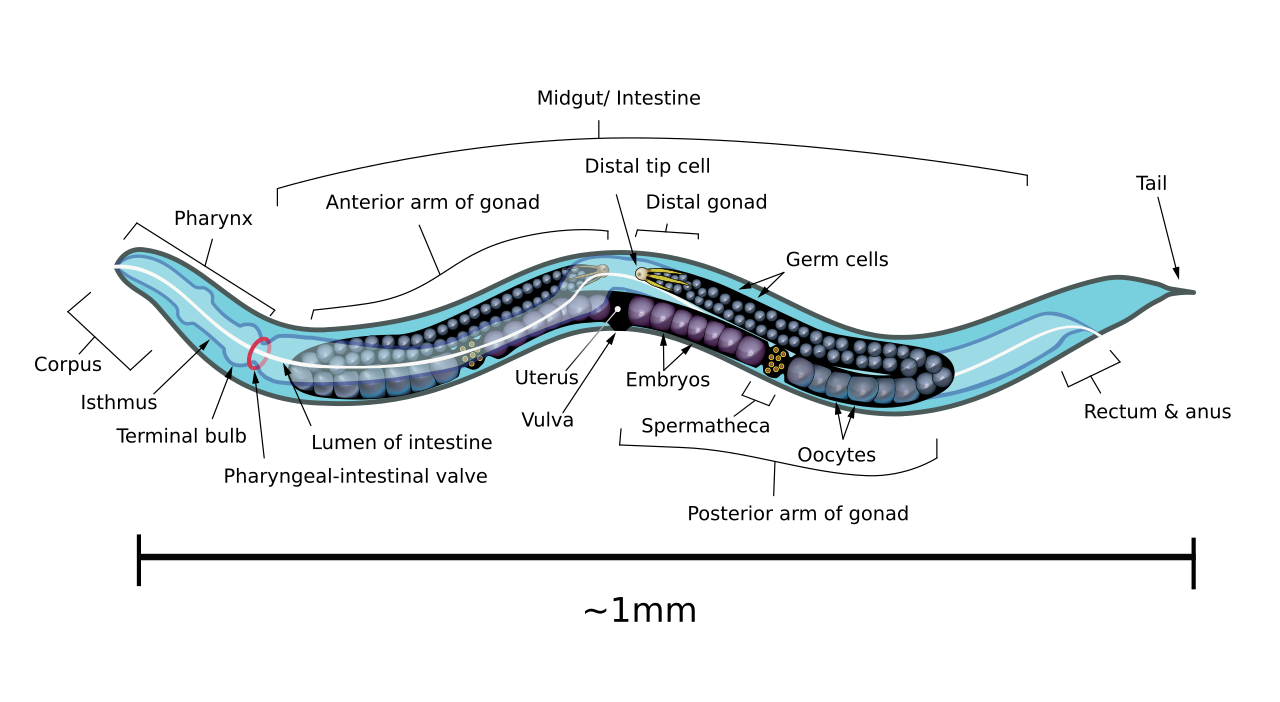
A lateral (left side) anatomical diagram of an adult-stage nematode hermaphroditeCaenorhabditis elegans (full size) with emphasis on the digestive and reproductive systems. C. elegans is a free-living, transparent nematode (roundworm) which measures about 1 millimetre (0.039in) in length. The hermaphrodite form, as seen here, is the most common, although a male form is also found. When self-inseminated, the species will lay about 300 eggs, but when the hermaphrodite is inseminated by a male, the number of progeny can exceed 1,000.
Platyhelminthes (fromAncient Greekπλατύ (platy)'flat'andἕλμινς (helmins)'parasitic worm') is a phylum of relatively simple bilaterian, unsegmented, soft-bodied invertebrates commonly called flatworms or flat worms. Being acoelomates (having no body cavity), and having no specialised circulatory and respiratoryorgans, they are restricted to having flattened shapes that allow oxygen and nutrients to pass through their bodies by diffusion. The digestive cavity has only one opening for both ingestion (intake of nutrients) and egestion (removal of undigested wastes); as a result, the food can not be processed continuously. (Full article...)
The maxima clam (Tridacna maxima) is a species of bivalve found throughout the Indo-Pacific. It is found on the surface of reefs or sand, or partly embedded in coral (as with this specimen), in the oceans surrounding east Africa, India, China, Australia, Southeast Asia and the islands of the Pacific. This clam is much sought after in the aquarium trade, as its often striking coloration—the result of crystalline pigment—mimics that of the true giant clam.
An illustration of various Pulmonata (and one predator arthropod in the lower right), an informal group of snails and slugs characterized by the ability to breathe air, by virtue of having a pallial lung instead of a gill, or gills. Pulmonata was previously a formal taxon but lost its status as one in 2010. The group includes many land and freshwater families, and several marine families. Most species have a shell, but no operculum, although the group does also include several shell-less slugs. Pulmonates are hermaphroditic, and some groups possess love darts.
Corals are marine invertebrates that typically live in compact colonies of many identical individual polyps. Each polyp is a sac-like animal typically only a few millimeters in diameter and a few centimeters in length. Corals are major contributors to the physical structure of the coral reefs such as the Great Barrier Reef, where this photograph was taken. Coral reefs are under threat globally from ocean acidification and climate change.
The Bryozoa (also known as the Polyzoa, Ectoprocta or commonly as moss animals) are a phylum of simple, aquaticinvertebrate animals, nearly all living in sedentary colonies. Typically about 0.5 millimetres (1⁄64in) long, they have a special feeding structure called a lophophore, a "crown" of tentacles used for filter feeding. The bryozoa are classified as the marine bryozoa (Stenolaemata), freshwater bryozoa (Phylactolaemata), and mostly-marine bryozoa (Gymnolaemata), a few members of which prefer brackish water. Most marine bryozoans live in tropical waters, but a few are found in oceanic trenches and polar waters. 5,869living species of bryozoa are known. Originally all of the crown group Bryozoa were colonial, but as an adaptation to a mesopsammal (interstitial spaces in marine sand) life or to deep-sea habitats, secondarily solitary forms have since evolved. Solitary species have been described in four genera: Aethozooides, Aethozoon, Franzenella, and Monobryozoon, the latter having a statocyst-like organ with a supposed excretory function. (Full article...)
Glaucus atlanticus is a species of small, blue sea slug. This pelagic aeolid nudibranch floats upside down, using the surface tension of the water to stay up, and is carried along by the winds and ocean currents. The blue side of their body faces upwards, blending in with the blue of the water, while the grey side faces downwards, blending in with the silvery surface of the sea. G.atlanticus feeds on other pelagic creatures, including the Portuguese man o' war.
The Atlantic spadefish is a species of marine fish endemic to the shallow waters off the coast of the southeastern United States and in the Caribbean Sea. They are similar in appearance to fresh waterangelfish, but much larger, reaching up to three feet (0.9 m) in length. Due to their reputation as strong fighters, they are popular game fish, especially during the summer months when they are most active.
Other official state dogs indigenous to their state include the Boston Terrier (Massachusetts) and the Alaskan Malamute (Alaska). Pennsylvania selected the Great Dane not because of its origin, but because it was introduced by early settlers in the state as a hunting and working dog; it was chosen over the Beagle which was also proposed around the same time. (Full article...)
Image 24Animals are unique in having the ball of cells of the early embryo (1) develop into a hollow ball or blastula (2). (from Animal)
Image 25A gun dog retrieving a duck during a hunt (from Animal)
Image 26Simplified schematic of an island's fauna – all its animal species, highlighted in boxes (from Fauna)
Image 27Idealised nephrozoan body plan. With an elongated body and a direction of movement the animal has head and tail ends. Sense organs and mouth form the basis of the head. Opposed circular and longitudinal muscles enable peristaltic motion. (from Animal)
Image 33A brilliantly-coloured oriental sweetlips fish (Plectorhinchus vittatus) waits while two boldly-patterned cleaner wrasse (Labroides dimidiatus) pick parasites from its skin. The spotted tail and fin pattern of the sweetlips signals sexual maturity; the behaviour and pattern of the cleaner fish signal their availability for cleaning service, rather than as prey. (from Animal coloration)
Image 34This frog changes its skin colour to control its temperature. (from Animal coloration)
Image 38Kelp gull chicks peck at red spot on mother's beak to stimulate the regurgitating reflex. (from Zoology)
Image 39A praying mantis in deimatic or threat pose displays conspicuous patches of colour to startle potential predators. This is not warning coloration as the insect is palatable. (from Animal coloration)
Image 41The microscopic cave snail Zospeumtholussum, found at depths of 743 to 1,392m (2,438 to 4,567ft) in the Lukina Jama–Trojama cave system of Croatia, is completely blind with a translucent shell (from Fauna)
The following table lists estimated numbers of described extant species for the animal groups with the largest numbers of species,[1] along with their principal habitats (terrestrial, fresh water,[2] and marine),[3] and free-living or parasitic ways of life.[4] Species estimates shown here are based on numbers described scientifically; much larger estimates have been calculated based on various means of prediction, and these can vary wildly. For instance, around 25,000–27,000 species of nematodes have been described, while published estimates of the total number of nematode species include 10,000–20,000; 500,000; 10 million; and 100 million.[5] Using patterns within the taxonomic hierarchy, the total number of animal species—including those not yet described—was calculated to be about 7.77 million in 2011.[6][7][a]
↑The application of DNA barcoding to taxonomy further complicates this; a 2016 barcoding analysis estimated a total count of nearly 100,000 insect species for Canada alone, and extrapolated that the global insect fauna must be in excess of 10 million species, of which nearly 2 million are in a single fly family known as gall midges (Cecidomyiidae).[8]
↑Stork, Nigel E. (January 2018). "How Many Species of Insects and Other Terrestrial Arthropods Are There on Earth?". Annual Review of Entomology. 63 (1): 31–45. doi:10.1146/annurev-ento-020117-043348. PMID28938083. S2CID23755007. Stork notes that 1m insects have been named, making much larger predicted estimates.
1234Nicol, David (June 1969). "The Number of Living Species of Molluscs". Systematic Zoology. 18 (2): 251–254. doi:10.2307/2412618. JSTOR2412618.
↑Sluys, R. (1999). "Global diversity of land planarians (Platyhelminthes, Tricladida, Terricola): a new indicator-taxon in biodiversity and conservation studies". Biodiversity and Conservation. 8 (12): 1663–1681. doi:10.1023/A:1008994925673. S2CID38784755.





.jpg)
_2.jpg)


_on_Bohadschia_argus_(Sea_cucumber).jpg)


.svg)


.jpg)


.png)

_Naggar,_Himachal_Pradesh,_2013_(cropped).JPG)


.jpg)


.jpg)


 Commons
 Wikidata
 Wikiquote
 Wikisource
 Wikispecies
 Wikiversity
 Wiktionary